 (No Ratings Yet)
 Loading...
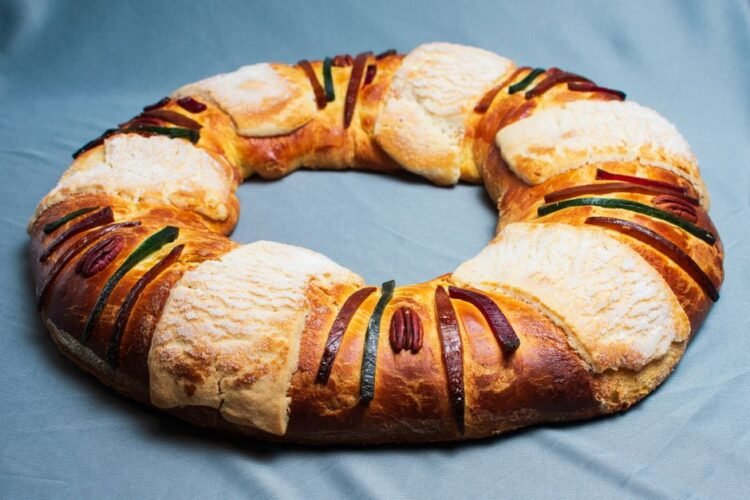
A festive Catalan sweet bread traditionally enjoyed on January 6th to celebrate Three Kings Day. This enriched, brioche-like ring is decorated with jewel-like candied fruits, toasted pine nuts, and whole almonds, and is often baked with a small figurine or dried bean hidden inside for good luck. Soft, fragrant with anise and citrus zest, it pairs beautifully with a cup of thick Spanish hot chocolate.
Prep Time30 mins
Cook Time35 mins
Total Time65 mins
Servings10
Yield10 slices
Nutrition Facts
Per serving (estimated)
- 385 kcalCalories
- 13 gFat
- 5 gSaturated Fat
- 58 gCarbs
- 2 gFiber
- 22 gSugar
- 8 gProtein
- 95 mgSodium
- 190 mgPotassium
- 65 mgCalcium
- 2.5 mgIron
- 5 mgVitamin C
- 85 mcgVitamin A
Ingredients
For the dough
- 500 g all-purpose flour
- 100 g granulated sugar
- 120 ml warm whole milk
- 80 g unsalted butter, softened
- 3 large eggs, room temperature
- 1 packet (7 g) active dry yeast
- Zest of 1 orange
- Zest of 1 lemon
- 2 tablespoons anise liqueur or 1 teaspoon anise seeds
- 1/2 teaspoon salt
- 1 teaspoon vanilla extract
For the filling and topping
- 80 g candied orange peel, chopped
- 60 g candied red cherries, halved
- 80 g whole blanched almonds
- 40 g pine nuts
- 1 small dried fava bean or porcelain figurine (optional, traditional)
- 3 tablespoons apricot jam, warmed
- 1 tablespoon water
- Powdered sugar, for dusting
Directions
- In a small bowl, combine the warm milk, yeast, and 1 teaspoon of the sugar; let stand for 8 to 10 minutes until foamy. In a large bowl, whisk together the flour, remaining sugar, salt, citrus zests, and anise seeds (if using).
- Make a well in the center and add the eggs, yeast mixture, softened butter, vanilla, and anise liqueur. Mix with a wooden spoon until a shaggy dough forms, then turn onto a lightly floured surface and knead for 10 to 12 minutes until smooth and elastic.
- Shape the dough into a ball, place in a greased bowl, cover with a kitchen towel, and let rise in a warm spot for 1 1/2 to 2 hours, until doubled in size. Line a baking sheet with parchment and lightly grease it.
- Punch down the dough and knead briefly. If using the hidden token, press it into the dough now. Shape the dough into a thick rope about 70 cm long, then join the ends on the prepared sheet to form a ring, pinching the seam to seal.
- Cover loosely and let the ring rise again for 30 to 40 minutes until puffy. Meanwhile, preheat the oven to 180°C (350°F).
- Press the candied orange peel and cherries into the top of the ring in colorful clusters. Scatter the whole almonds and pine nuts generously over the surface, gently pressing them into the dough so they adhere.
- Bake on the center rack for 30 to 35 minutes, until the cake is deep golden brown and sounds hollow when tapped. If the nuts brown too quickly, tent loosely with foil for the last 10 minutes.
- Warm the apricot jam with 1 tablespoon of water and brush it over the warm cake to give the toppings a glossy finish. Cool on the sheet for 15 minutes, then transfer to a wire rack and dust generously with powdered sugar before slicing.
Cook’s Notes
- The cake rises twice, so plan for about 3 hours of total inactive rising time before baking.
- Whichever guest finds the hidden fava bean or figurine in their slice is said to have good luck for the coming year (and traditionally buys the cake the following year).
- For best flavor, let the dough rest overnight in the refrigerator after the first rise; this slow fermentation deepens the citrus and anise notes.
- Serve slices with a small bowl of thick Spanish hot chocolate for dunking, the customary Catalan pairing.
- Store leftovers wrapped at room temperature for up to 3 days, or freeze undecorated cake for up to 1 month.