 (No Ratings Yet)
 Loading...
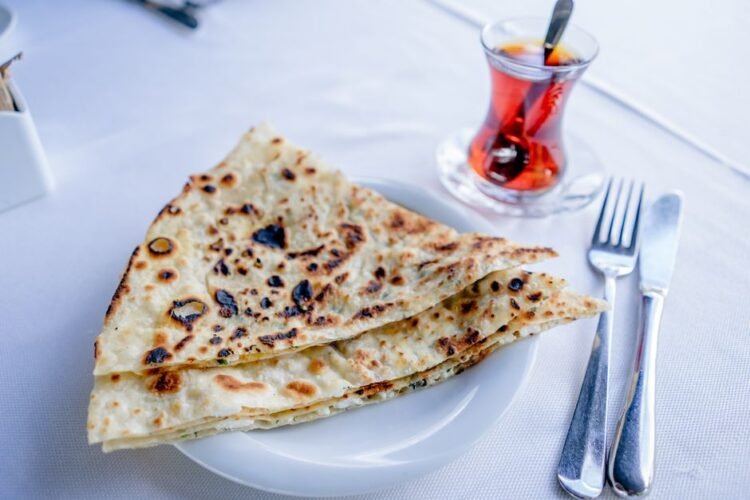
El acmasi means "hand-opened" in Turkish, and this rustic Anatolian pastry showcases that technique: balls of enriched yeasted dough are pulled paper-thin by fingertips, then folded around a savory filling before a quick bake. The result is a beautifully blistered flatbread with crisp, flaky edges and a tender, layered center. Served warm with butter and a glass of ayran, it is the kind of breakfast or tea-time staple that defines Turkish home cooking.
Prep Time25 mins
Cook Time25 mins
Total Time50 mins
Servings4
Yield4 stuffed flatbreads
Nutrition Facts
Per serving (estimated)
- 610 kcalCalories
- 28 gFat
- 11 gSaturated Fat
- 72 gCarbs
- 3 gFiber
- 4 gSugar
- 19 gProtein
- 780 mgSodium
- 380 mgPotassium
- 240 mgCalcium
- 3.8 mgIron
- 10 mgVitamin C
- 180 mcgVitamin A
Ingredients
For the dough
- 2 1/2 cups (320 g) all-purpose flour, plus more for dusting
- 1 tsp (4 g) instant yeast
- 1 tsp granulated sugar
- 1 tsp fine sea salt
- 3/4 cup (180 ml) warm whole milk
- 2 tbsp plain whole-milk yogurt
- 2 tbsp extra-virgin olive oil
- 1 large egg, room temperature
For the potato and feta filling
- 2 medium russet potatoes (about 350 g), peeled and cubed
- 1 cup (140 g) crumbled Turkish beyaz peynir or feta
- 1/2 cup (60 g) shredded aged kashar or mozzarella
- 1 small yellow onion, finely chopped
- 2 tbsp chopped fresh dill
- 2 tbsp chopped flat-leaf parsley
- 1/2 tsp ground sumac
- 1/4 tsp freshly ground black pepper
For brushing and topping
- 3 tbsp unsalted butter, melted
- 1 egg yolk beaten with 1 tbsp whole milk
- 1 tsp nigella seeds or sesame seeds, optional
Directions
- Make the dough: In a large bowl, whisk the flour, yeast, sugar, and salt. Stir in the warm milk, yogurt, olive oil, and egg until a shaggy dough forms, then knead on a lightly floured surface for 8 to 10 minutes until smooth and elastic. Place in an oiled bowl, cover, and rest for at least 30 minutes at room temperature.
- Meanwhile, prepare the filling: Boil the potatoes in salted water until fork-tender, about 12 minutes; drain well and mash until smooth. In a skillet over medium heat, sauté the onion in 1 tablespoon of the melted butter until soft and lightly golden, about 5 minutes. Combine the mashed potatoes with the sautéed onion, both cheeses, dill, parsley, sumac, and pepper; season to taste and let cool completely.
- Divide the rested dough into 4 equal pieces and roll each into a tight ball. Cover and let the balls rest for 10 more minutes so the gluten relaxes for easier stretching.
- Hand-stretch each ball: on a clean, lightly floured tablecloth or countertop, press a dough ball flat with your fingertips, then stretch it outward from the center with the backs of your hands, rotating constantly, until you have a thin round about 25 cm (10 inches) across and nearly translucent in the middle. The edges will be slightly thicker.
- Spoon one-quarter of the filling along the center of each stretched round. Fold the two opposite edges over the filling, then fold the short ends in to make a flat rectangular packet, pinching seams tightly to seal.
- Preheat the oven to 220°C (425°F) with a heavy baking sheet or pizza stone inside. Brush each pastry generously with the egg yolk and milk wash, scatter with nigella or sesame seeds if using, and slide onto the preheated surface. Bake for 18 to 22 minutes until deeply golden and blistered.
- Immediately after removing from the oven, brush the hot pastries with the remaining melted butter so it soaks into the layers. Let rest 3 minutes, then cut and serve hot with extra butter, olives, or a wedge of tomato and cucumber on the side.
Cook’s Notes
- A long, warm rest (30 to 60 minutes) is the secret to dough that cooperates; cold, tight dough will spring back and resist stretching.
- Keep your knuckles close to the counter and stretch from the center outward, rotating the dough like a clock so thickness stays even; never press the very edge or it will tear.
- A lightly floured cotton tablecloth works better than a wooden board for hand-stretching because the dough grips slightly and slides gently as you pull.
- If a tear appears, pinch it closed and dust with flour; small flaws add to the rustic character after baking.
- For extra flakiness, brush a little melted butter between each fold before sealing the packet.