 (No Ratings Yet)
 Loading...
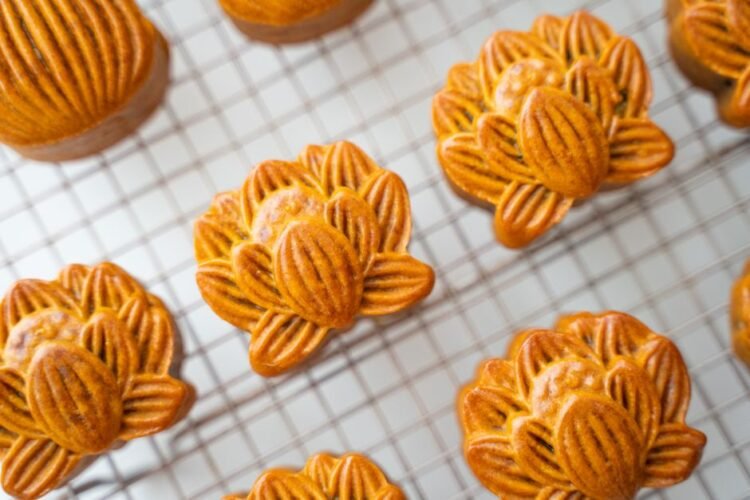
A classic Vietnamese baked mooncake made for the Mid-Autumn Festival, featuring a glossy golden crust wrapped around velvety lotus seed paste and a briny salted duck egg yolk at the center. The cake's distinctive crackled top and tender, fragrant crumb develop as it rests for a day or two after baking.
Prep Time30 mins
Cook Time25 mins
Total Time55 mins
Servings6
Yield6 mooncakes
Nutrition Facts
Per serving (estimated)
- 385 kcalCalories
- 17 gFat
- 4 gSaturated Fat
- 52 gCarbs
- 2 gFiber
- 26 gSugar
- 8 gProtein
- 290 mgSodium
- 160 mgPotassium
- 55 mgCalcium
- 3 mgIron
- 1 mgVitamin C
- 85 mcgVitamin A
Ingredients
For the dough
- 250 g cake flour
- 100 g golden syrup
- 50 ml peanut oil
- 1 tsp alkaline water (lye water)
- Pinch of salt
For the filling
- 350 g ready-made lotus seed paste
- 6 salted duck egg yolks, rinsed and patted dry
- 2 tbsp roasted melon seeds
- 30 g candied winter melon, finely diced
For the egg wash
- 1 small egg yolk
- 1 tsp whole milk
- 1/2 tsp golden syrup
Directions
- Preheat the oven to 180°C (350°F) and lightly grease a baking sheet. In a mixing bowl, whisk together golden syrup, peanut oil, alkaline water, and salt until smooth, then sift in the cake flour and stir with a spatula just until a soft, pliable dough forms. Cover and rest for 20 minutes.
- While the dough rests, prepare the filling: divide lotus seed paste into 6 equal portions (about 60 g each). Flatten each portion into a disc in your palm, place a salted egg yolk in the center, sprinkle with a few melon seeds and candied melon, then enclose the yolk completely and roll into a smooth ball.
- Divide the rested dough into 6 equal pieces (about 65 g each) and roll each into a ball. Flatten a dough ball into a thin round about 10 cm wide, then wrap it around a filling ball, pressing gently to seal. Lightly dust the outside with a little cake flour.
- Press each filled dough ball firmly into a traditional wooden mooncake mold (about 75 g capacity) to imprint the pattern, then tap the mold to release the cake onto the prepared baking sheet. Repeat with the remaining dough and filling.
- Bake the mooncakes for 10 minutes, then remove from the oven and let cool for 5 minutes. Meanwhile, whisk the egg yolk with milk and golden syrup to make a smooth glaze. Brush a very thin layer of glaze over each cake.
- Return the mooncakes to the oven and bake for another 12 to 15 minutes, until the tops are deep golden brown and the edges look set. Transfer to a wire rack and let cool completely.
- Store the mooncakes in an airtight container at room temperature for at least 24 to 48 hours before serving, which allows the crust to soften and the flavors to mellow.
- Serve at room temperature, traditionally paired with a pot of jasmine or lotus tea during the Mid-Autumn Festival.
Cook’s Notes
- If golden syrup is unavailable, substitute with a mixture of 80 g honey and 20 g light corn syrup, lightly warmed.
- Alkaline water (lye water) is essential for the golden color and characteristic crust; look for it in Asian grocery stores or substitute with a pinch of baked baking soda dissolved in water.
- Do not skip the resting period of 1 to 2 days after baking; the crust will be crumbly at first but will soften into the traditional tender texture.
- For an extra-glossy finish, brush the egg wash on twice: once before baking and once again halfway through the second bake.
- Use a kitchen scale to weigh each dough and filling portion for perfectly uniform mooncakes that fit your mold cleanly.