 (No Ratings Yet)
 Loading...
Buss Up Shut, literally "burst shirt" in Trinidadian Creole, is the signature flaky shredded paratha roti of Trinidad and Tobago. Each roti is rolled thin, layered with ghee, then beaten on a hot tawa until it splinters into soft, buttery strips that resemble a torn-up shirt. It is the essential scoop-and-wrap vehicle for chana, potato curry, or any saucy curry on a Sunday lunch table.
Prep Time45 mins
Cook Time25 mins
Total Time70 mins
Servings8
Yield8 paratha rotis
Nutrition Facts
Per serving (estimated)
- 295 kcalCalories
- 13 gFat
- 5 gSaturated Fat
- 39 gCarbs
- 3 gFiber
- 1 gSugar
- 6 gProtein
- 360 mgSodium
- 90 mgPotassium
- 28 mgCalcium
- 2.2 mgIron
- 0 mgVitamin C
- 8 mcgVitamin A
Ingredients
For the Dough
- 3 cups (375 g) all-purpose flour
- 1 cup (120 g) whole wheat atta flour
- 1 1/2 tsp baking powder
- 1 1/2 tsp fine sea salt
- 1 tsp granulated sugar
- 1/4 cup (55 g) ghee, melted
- 1 tbsp neutral vegetable oil
- 1 cup to 1 1/4 cups warm water, as needed
For Layering and Cooking
- 1/3 cup (75 g) ghee, softened to a paste
- 1/4 cup (55 ml) neutral vegetable oil
- Extra flour for rolling
Directions
- In a large mixing bowl, whisk together the all-purpose flour, atta flour, baking powder, salt, and sugar. Drizzle in the melted ghee and oil, then rub with your fingertips until the mixture looks like fine damp sand.
- Pour in 1 cup of the warm water and mix with one hand, adding more water a tablespoon at a time, until a soft, slightly tacky dough forms. Turn out onto a clean surface and knead for 8 to 10 minutes until smooth and elastic; it should spring back when poked.
- Shape the dough into a ball, coat lightly with oil, cover with a damp kitchen towel, and rest for at least 30 minutes, or up to 2 hours, to relax the gluten so the rotis roll paper-thin.
- Divide the rested dough into 8 equal pieces and roll each into a smooth ball. Coat the balls in a little oil so they do not skin over while you work.
- Working one ball at a time, roll out on a lightly floured counter into a thin oval about 8 inches long and 1/16-inch thick. Brush the surface with a thin layer of softened ghee, leaving a half-inch border around the edges.
- Pleat the oval like an accordion into a long 1-inch-wide strip, then coil the strip into a tight snail spiral. Tuck the loose end underneath, press down gently, and set aside. Repeat with all 8 balls, then let the coils rest 10 minutes under a towel.
- Pat each coil flat with your palm and roll out on a lightly floured surface into a 7- to 8-inch round, keeping the layer lines visible. Do not press too hard or the ghee will ooze out.
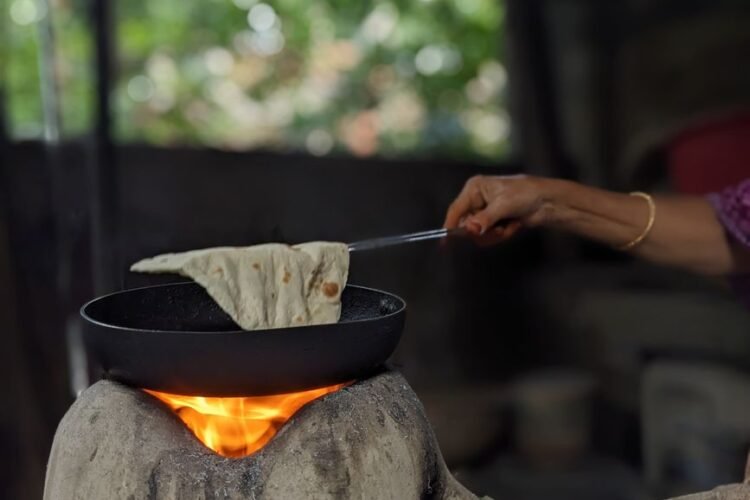
- Heat a heavy cast-iron tawa or dry skillet over medium-high until a drop of water skitters across the surface. Lay one roti on the hot griddle and cook 60 to 90 seconds, until pale golden spots appear on the underside.
- Flip the roti, brush the cooked side with a teaspoon of oil, then flip again and brush the other side. As the roti puffs and goldens, grip it at the edges with two clean paper towels or a dry tea towel and clap it firmly against the griddle 4 to 6 times to shatter it into flaky layers this is the buss up shut effect.
- Transfer the shredded roti to a plate and keep wrapped in a clean tea towel while you cook the rest. Serve hot, piled up, alongside chickpea curry, aloo, or any leftover curry for tearing and scooping.
Cook’s Notes
- The dough must rest fully; skipping this step makes the rotis spring back and resist rolling paper-thin, which ruins the flaky layers.
- For the most dramatic burst-shirt tear, keep your tawa very hot so the roti puffs aggressively before you beat it apart, otherwise the layers stay glued together.
- Use ghee rather than butter for layering; the higher smoke point and nutty aroma are essential to authentic Trinidadian flavor and pale color.
- Keep finished rotis tightly stacked under a dry tea towel (never plastic) so the internal steam keeps every layer soft and pliable until serving.
- If you are new to the clapping technique, use two paper towels as a shield for your hands the griddle should be hot but not scorching, and the roti will tear naturally along its lamination lines.