 (No Ratings Yet)
 Loading...
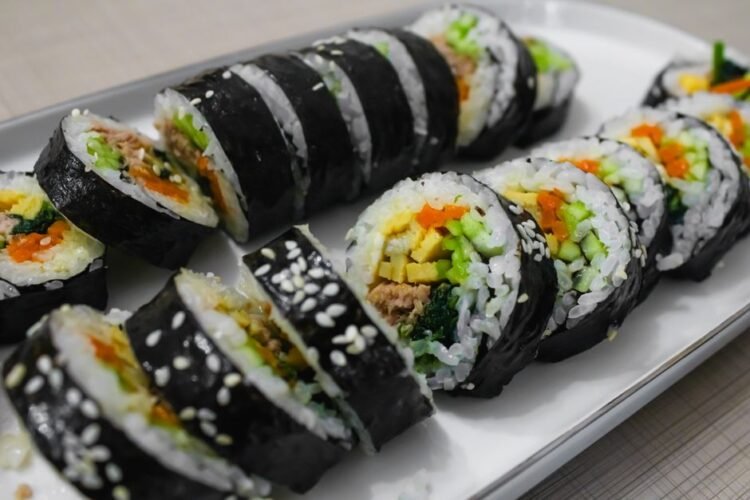
Gimbap is a beloved Korean street food featuring seasoned rice and colorful fillings rolled tightly in crisp seaweed sheets. This version pairs savory beef, tender spinach, sweet carrot, and tangy pickled radish for the perfect balance of flavors and textures. Sliced into bite-sized rounds, it makes a satisfying lunch, picnic dish, or party platter.
Prep Time35 mins
Cook Time25 mins
Total Time60 mins
Servings4
Yield4 servings (8 rolls)
Nutrition Facts
Per serving (estimated)
- 520 kcalCalories
- 14 gFat
- 3.5 gSaturated Fat
- 75 gCarbs
- 4 gFiber
- 4 gSugar
- 24 gProtein
- 720 mgSodium
- 520 mgPotassium
- 110 mgCalcium
- 4 mgIron
- 9 mgVitamin C
- 280 mcgVitamin A
Ingredients
For the rice
- 2 cups Korean short-grain white rice
- 2 1/4 cups water
- 1 tablespoon toasted sesame oil
- 1 teaspoon fine sea salt
For the beef filling
- 200 g (7 oz) beef sirloin, thinly sliced into strips
- 1 tablespoon soy sauce
- 1 teaspoon sugar
- 1 teaspoon toasted sesame oil
- 1 clove garlic, minced
- Pinch of black pepper
For the vegetable fillings
- 150 g (5 oz) fresh spinach
- 1/2 teaspoon salt (for blanching)
- 1 medium carrot, julienned
- 1/2 English cucumber, julienned
- 100 g (3.5 oz) yellow pickled radish (danmuji), julienned
- 1 teaspoon toasted sesame oil
For the egg and assembly
- 3 large eggs, beaten with a pinch of salt
- 5 sheets gim (toasted nori seaweed)
- Extra sesame oil for brushing
- 1 tablespoon toasted sesame seeds
Directions
- Rinse the rice in cold water 3 to 4 times until the water runs almost clear, then drain. Combine with the measured water in a rice cooker and cook until tender, about 25 minutes. While still hot, gently fold in the sesame oil and salt, then spread on a wide platter to cool slightly.
- Marinate the sliced beef with soy sauce, sugar, sesame oil, garlic, and black pepper for 10 minutes. Heat a nonstick skillet over medium-high and stir-fry the beef for 3 to 4 minutes until just cooked through. Transfer to a plate to cool completely.
- Blanch the spinach in boiling salted water for 30 seconds, then immediately shock in ice water. Squeeze out excess moisture, chop roughly, and toss with 1/2 teaspoon sesame oil and a pinch of salt. In the same skillet, lightly sauté the carrot with a pinch of salt for 2 minutes until just tender. Set carrots and cucumber aside separately.
- Whisk the eggs with a pinch of salt and cook in a lightly oiled nonstick pan over medium-low to form a thin omelette, about 1 to 2 minutes per side. Cool, then slice into 1/2 cm (1/4 inch) strips.
- Place a sheet of gim shiny-side down on a bamboo rolling mat. With damp hands, spread about 3/4 cup of the seasoned rice evenly over the seaweed, leaving a 2 cm (3/4 inch) border at the far edge. Lightly press a sprinkle of sesame seeds into the rice.
- Lay a small strip of beef, a line of spinach, carrot, cucumber, egg, and pickled radish across the rice about one-third of the way up from the edge nearest you. Using the mat, lift the edge and roll forward, tucking the filling tightly and pressing firmly to shape. Wet the bare seaweed edge with a finger of water to seal the roll.
- Repeat with the remaining gim sheets, rice, and fillings to make 5 rolls total. Brush each roll lightly with sesame oil and let rest seam-side down for 2 minutes so they hold their shape.
- Using a sharp knife dampened with water, slice each roll into 6 to 8 even rounds about 2 cm (3/4 inch) thick. Wipe the blade between cuts for clean edges. Arrange on a platter and serve at room temperature.
Cook’s Notes
- Dampen your hands when handling the seasoned rice to prevent it from sticking and to keep the grains from turning mushy.
- Always cool the fillings completely before assembling; warm ingredients will make the seaweed soggy and the rice greasy.
- Wet your knife blade with a little water before each cut to get clean, even slices without tearing the roll.
- For the neatest rolls, use a bamboo mat (makisu) and apply firm, even pressure with each turn.
- Store leftover rolls wrapped tightly in plastic wrap and refrigerate for up to 1 day; bring to room temperature before serving.