 (No Ratings Yet)
 Loading...
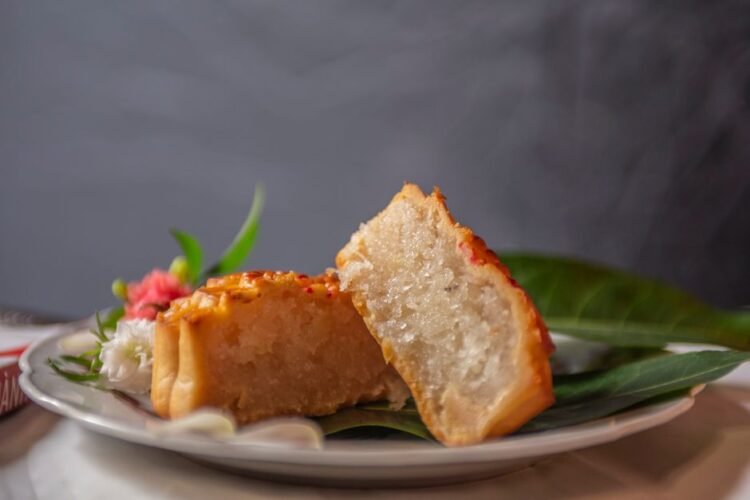
A beloved traditional Indonesian street snack, sweet fermented cassava is made by culturing cooked cassava with a rice-flour yeast starter until it turns soft, juicy, and naturally sweet with hints of tropical fruit. The fermentation process breaks down starches into simple sugars, creating a snack that is gently effervescent and dessert-like without any added syrup.
Prep Time20 mins
Cook Time25 mins
Total Time45 mins
Servings4
Yield4 servings
Nutrition Facts
Per serving (estimated)
- 355 kcalCalories
- 0.6 gFat
- 0.1 gSaturated Fat
- 84 gCarbs
- 4 gFiber
- 14 gSugar
- 3 gProtein
- 160 mgSodium
- 700 mgPotassium
- 45 mgCalcium
- 0.7 mgIron
- 52 mgVitamin C
- 0 mcgVitamin A
Ingredients
For the cassava
- 1 kg fresh cassava root (about 2.2 lb), peeled
- 1/2 tsp fine sea salt
- 2 cups water, for boiling
For the fermentation
- 2 tbsp granulated sugar
- 1/2 tsp (about 1 g) ragi tape fermentation starter, crumbled
- 1 banana leaf, softened over a flame (optional, for lining)
Directions
- Peel the cassava root with a sharp knife, slice it in half lengthwise, and remove the woody central fiber. Cut the flesh into 3 cm (1.25 inch) chunks.
- Place the cassava chunks in a pot, cover with the salted water, and bring to a boil over medium-high heat. Reduce to a simmer and cook for 15 minutes, until the cassava is just tender but still holds its shape (a skewer should slide in with slight resistance).
- Drain the cassava thoroughly and spread the chunks on a clean kitchen towel. Pat dry and let them cool to lukewarm, about 30 minutes, so the heat does not kill the yeast.
- Sprinkle the crumbled ragi tape and the sugar evenly over the warm cassava chunks. Toss very gently with clean hands or a spatula so each piece is lightly coated.
- Line a glass or ceramic dish with the softened banana leaf if using, then arrange the cassava in a single layer. Cover tightly with plastic wrap or a lid to keep moisture in while allowing minimal airflow.
- Let the cassava ferment at warm room temperature (around 28-30°C / 82-86°F) for 36 to 48 hours. By the end, the chunks should be soft, slightly sticky, and noticeably sweet with a fruity aroma.
- Uncover the dish, give the cassava a gentle stir, and taste. If it is sweet enough, chill it for 30 minutes before serving; if you prefer it sweeter, ferment for another 12 hours.
- Spoon the fermented cassava into small bowls and serve chilled or at cool room temperature, drizzling any syrupy liquid pooled at the bottom of the dish over the top.
Cook’s Notes
- Choose fresh, firm cassava with no black spots or woody streaks; very old roots can ferment unevenly and taste bitter.
- Do not overcook the cassava before fermenting; it should keep its shape so the chunks don't turn into a paste during fermentation.
- Keep the fermentation environment warm and steady; if your kitchen is cool, place the dish inside a turned-off oven with just the pilot light or near a warm appliance.
- Do not ferment longer than 72 hours or the flavor will turn sharply sour and alcoholic rather than pleasantly sweet and fruity.
- Serve with a small bowl of grated coconut or a few slices of ripe mango for a classic Indonesian pairing.