 (No Ratings Yet)
 Loading...
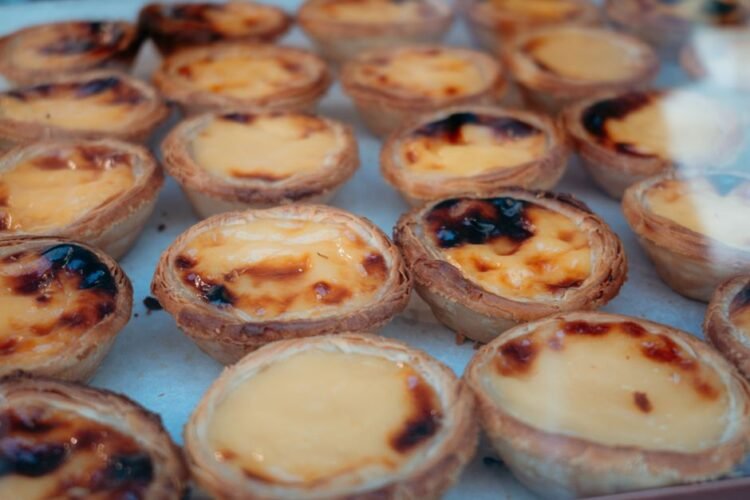
These iconic Chinese egg tarts feature a tender, cookie-like butter crust holding a silky, lightly sweetened egg custard. They are a staple of Hong Kong dim sum and tea houses, descended from the Portuguese pastel de nata via Macau. Best enjoyed warm, when the custard is still just-set and trembling in the center.
Prep Time30 mins
Cook Time25 mins
Total Time55 mins
Servings8
Yield8 egg tarts
Nutrition Facts
Per serving (estimated)
- 285 kcalCalories
- 15 gFat
- 9 gSaturated Fat
- 31 gCarbs
- 1 gFiber
- 14 gSugar
- 6 gProtein
- 115 mgSodium
- 95 mgPotassium
- 65 mgCalcium
- 1.4 mgIron
- 0.3 mgVitamin C
- 280 mcgVitamin A
Ingredients
For the butter pastry crust
- 1 1/2 cups (190 g) all-purpose flour
- 1/2 cup (113 g) cold unsalted butter, cubed
- 1/4 cup (30 g) powdered sugar
- 1 large egg yolk
- 2 to 3 tablespoons ice water
- 1/4 teaspoon fine salt
For the egg custard filling
- 3/4 cup (180 ml) whole milk
- 1/4 cup (60 ml) heavy cream
- 3 large eggs, room temperature
- 1/2 cup (100 g) granulated sugar
- 1/2 teaspoon vanilla extract
- Pinch of fine salt
Directions
- Make the pastry: pulse flour, powdered sugar, and salt in a food processor, then add cold butter and pulse until the mixture looks like coarse crumbs. Add the egg yolk and 2 tablespoons of ice water and pulse just until the dough begins to clump together.
- Turn the dough out onto a sheet of plastic wrap, press into a 1-inch-thick disc, wrap tightly, and refrigerate for 20 minutes until firm enough to roll.
- Preheat the oven to 375°F (190°C). Lightly grease eight 2 1/2-inch tartlet pans (or a standard muffin tin).
- On a lightly floured surface, roll the chilled dough to about 1/8-inch thickness. Cut rounds slightly larger than your tartlet pans and gently press each round into a pan, patching any tears. Trim the edges flush with the rim. Prick the bases with a fork and chill the lined pans while you prepare the custard.
- Make the custard: warm the milk and cream together in a small saucepan over low heat until just steaming, not boiling. In a separate bowl, whisk the eggs, sugar, vanilla, and salt until the sugar mostly dissolves, then slowly whisk in the warm milk mixture.
- Strain the custard through a fine-mesh sieve into a measuring cup with a spout, which removes bubbles and any bits of cooked egg for a perfectly smooth texture.
- Pour the custard into the chilled tart shells, filling each about 80% full (the custard will puff slightly as it bakes).
- Bake on the middle rack for 20 to 25 minutes, until the crust is golden and the custard is just set with a faint jiggle in the center. If the tops brown too quickly, tent loosely with foil.
- Cool the tarts in their pans for 5 minutes, then carefully unmold onto a wire rack. Serve warm or at room temperature, ideally the same day they are baked.
Cook’s Notes
- For the silkiest custard, strain it twice through a fine-mesh sieve before pouring into the shells.
- Do not overbake: the center should still wobble slightly when you tap the pan; it will continue to set as it cools.
- Keep all pastry ingredients very cold and work quickly to ensure a tender, shortbread-like crust rather than a tough one.
- If you do not have tartlet pans, a standard muffin tin works well; just grease it well and skip trimming the edges.
- For a more traditional flaky version, swap the shortcrust for store-bought puff pastry and blind-bake the shells for 8 minutes before adding the custard.