 (No Ratings Yet)
 Loading...
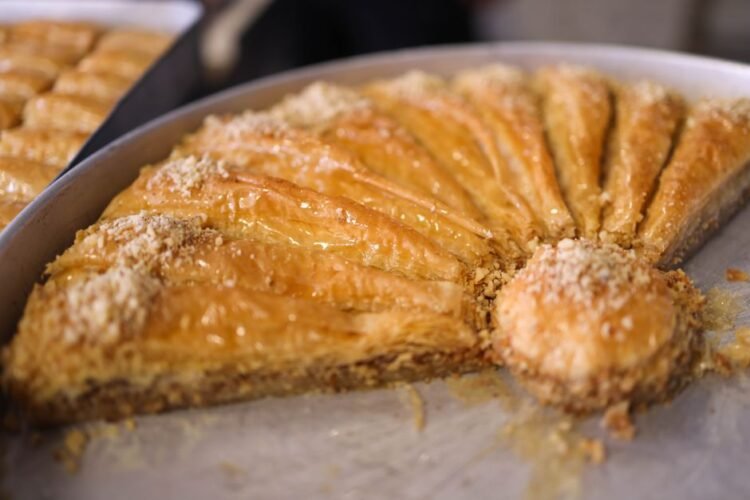
A beloved Maghreb pastry, Tunisian baklava layers paper-thin phyllo around a fragrant almond filling perfumed with orange blossom water and cinnamon. After baking until shatter-gold, the whole tray is drenched in a honey-lemon syrup that soaks in overnight for the classic syrupy, melt-in-the-mouth texture. It is a fixture at weddings, Eid celebrations, and afternoon tea across Tunisia.
Prep Time35 mins
Cook Time40 mins
Total Time75 mins
Servings10
Yield20 diamond pieces
Nutrition Facts
Per serving (estimated)
- 445 kcalCalories
- 26 gFat
- 11 gSaturated Fat
- 49 gCarbs
- 3 gFiber
- 31 gSugar
- 7 gProtein
- 180 mgSodium
- 195 mgPotassium
- 75 mgCalcium
- 1.8 mgIron
- 1 mgVitamin C
- 280 mcgVitamin A
Ingredients
For the orange blossom syrup
- 1 cup honey
- 1/2 cup granulated sugar
- 3/4 cup water
- 1 tablespoon fresh lemon juice
- 1 strip lemon peel
- 1 tablespoon orange blossom water
For the almond filling
- 2 cups blanched almonds, finely ground
- 1/3 cup granulated sugar
- 1 teaspoon ground cinnamon
- 2 tablespoons orange blossom water
- 2 tablespoons unsalted butter, melted
- Pinch of fine salt
For the pastry layers
- 1 pound package phyllo dough (about 20 sheets), thawed
- 1 cup unsalted butter, melted
- 2 tablespoons olive oil
- 1/4 cup sliced blanched almonds, for topping
Directions
- Make the syrup first so it can cool: combine honey, sugar, water, lemon juice, and lemon peel in a small saucepan. Bring to a gentle boil over medium heat, stirring until the sugar dissolves, then simmer 8 to 10 minutes until lightly thickened. Remove from heat, discard the peel, and stir in the orange blossom water. Set aside to cool completely.
- Prepare the filling by stirring together the ground almonds, sugar, cinnamon, salt, melted butter, and orange blossom water until a soft, slightly sticky paste forms. Set aside.
- Position a rack in the middle of the oven and preheat to 350°F (175°C). Lightly butter a 9×13-inch baking dish. Unroll the phyllo and keep the stack covered with a barely damp kitchen towel so it does not dry out.
- Layer 10 sheets of phyllo in the dish, brushing each sheet generously with the melted butter mixed with olive oil. Spread the almond filling evenly over the top, pressing it gently into a thin, even layer. Cover with the remaining 10 sheets of phyllo, buttering each sheet as you go, then brush the top with a final coat of butter.
- Using a sharp knife, score the top layer diagonally in both directions to form diamond shapes, cutting only about two-thirds of the way through. Sprinkle the sliced almonds over the top and press them in lightly.
- Bake for 35 to 40 minutes, until the top is deeply golden and crisp and the pastry sounds hollow when tapped. If the top browns too quickly, tent loosely with foil for the last 10 minutes.
- As soon as the baklava comes out of the oven, slowly pour the cooled syrup evenly over the hot pastry. You will hear a satisfying sizzle as it absorbs. Reserve any remaining syrup for drizzling.
- Let the baklava rest at room temperature for at least 6 hours, preferably overnight, so the syrup fully penetrates the layers. Re-cut along the scored lines before serving.
Cook’s Notes
- Orange blossom water is potent, so measure carefully; for a more floral Tunisian profile add a few drops of rose water as well.
- Always pour cooled syrup over hot baklava, not the other way around; pouring hot syrup on cool pastry can make it soggy rather than properly soaked.
- For a pistachio-almond variation, replace half of the almonds with unsalted pistachios for a green-flecked filling common in coastal Tunisian sweets.
- Baklava keeps well covered at room temperature for up to a week and actually improves in flavor after the first day as the syrup mellows.
- If using homemade warqa sheets instead of phyllo, reduce baking time by about 5 minutes as warqa browns faster.