 (No Ratings Yet)
 Loading...
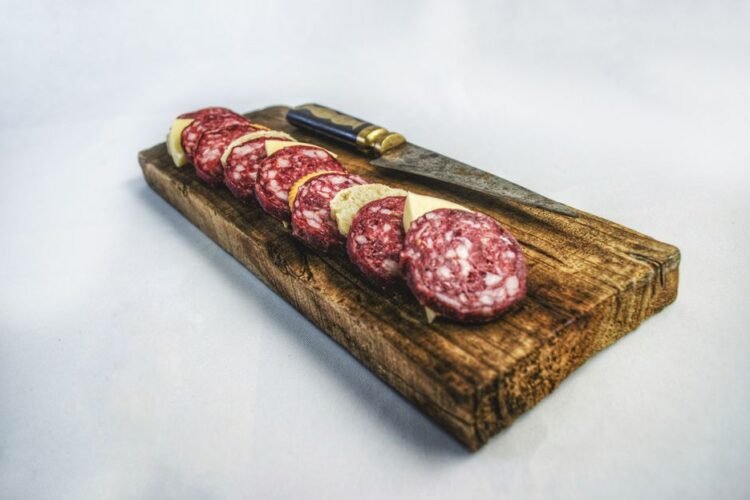
A traditional dry-cured pork sausage from Lyon, rosette is prized for its coarse texture, deep rosy-red color, and aromatic blend of garlic, cracked pepper, and red wine. Making it at home rewards patience, as the sausage is slowly air-dried for several weeks to concentrate its flavor and develop its signature firm, sliceable bite.
Prep Time90 mins
Cook Time0 mins
Total Time90 mins
Servings10
Yield1 salami (about 1 kg, 10 servings of 50 g slices)
Nutrition Facts
Per serving (estimated)
- 180 kcalCalories
- 14 gFat
- 5 gSaturated Fat
- 1 gCarbs
- 0 gFiber
- 0 gSugar
- 11 gProtein
- 720 mgSodium
- 170 mgPotassium
- 10 mgCalcium
- 0.7 mgIron
- 0 mgVitamin C
- 5 mcgVitamin A
Ingredients
For the meat mixture
- 800 g pork shoulder, cut into 2.5 cm cubes and chilled until firm
- 200 g pork back fat, cut into 1 cm cubes
- 22 g fine sea salt
- 3 g curing salt (Prague powder #2, 6.25% sodium nitrite)
- 150 ml dry red wine, such as Beaujolais
- 6 garlic cloves, finely minced
For the spice blend
- 15 g coarsely cracked black pepper
- 5 g white pepper
- 3 g freshly grated nutmeg
- 2 g ground mace
- 2 g ground cloves
- 1 g piment d'Espelette or cayenne pepper (optional)
For casing and finishing
- 1 natural hog casing (32-38 mm), soaked in warm water 30 minutes and rinsed
- Butcher's twine, for tying
- Cheesecloth, for wrapping during drying
Directions
- Combine the cubed pork shoulder and back fat in a large bowl, sprinkle with sea salt and curing salt, toss thoroughly to coat, cover, and refrigerate for 24 hours to cure.
- Pat the cured meat dry with paper towels and pass it through a meat grinder fitted with a coarse 8-10 mm plate, keeping the meat and grinder well-chilled to preserve fat texture.
- Whisk the red wine, minced garlic, cracked black pepper, white pepper, nutmeg, mace, cloves, and piment d'Espelette together in a small bowl, then pour evenly over the ground meat.
- Massage the seasoning into the meat with clean hands for 5-7 minutes until sticky and uniformly blended, cover, and return to the refrigerator for 12 hours so the spices meld.
- Fit a sausage stuffer with a 22-25 mm horn, slide the soaked hog casing onto the nozzle leaving 5 cm overhang, and pack the meat in tightly to avoid air pockets.
- Stuff the casing slowly and evenly until firm but not taut, tie the open end securely with butcher's twine, and prick any visible air bubbles with a sterilized pin.
- Hang the salami in a clean, draft-free space at 20-22°C (68-72°F) with 85-90% relative humidity for 48-72 hours to ferment, until the surface feels tacky and smells slightly tangy.
- Move the salami to a drying environment at 12-15°C (54-59°F) with 70-75% humidity for 4-6 weeks; after the first week wrap it loosely in a single layer of cheesecloth to protect from insects.
- The rosette is ready when it has lost roughly 30-35% of its original weight, the casing feels firm, and a thin slice reveals evenly distributed pepper flecks in a deep ruby-red matrix.
- Slice very thinly with a sharp long knife and serve at cool room temperature with crusty baguette, cornichons, coarse mustard, and a glass of Beaujolais or Côtes du Rhône.
Cook’s Notes
- Curing salt (sodium nitrite) is essential for safe dry-curing and gives rosette its characteristic rosy hue; do not substitute with regular salt.
- Precise temperature and humidity control during drying are critical — use a hygrometer and ideally a converted refrigerator or wine fridge for consistent results.
- Natural ambient bacteria typically drive the fermentation without needing a starter culture, but sanitize all tools, hands, and surfaces thoroughly beforehand.
- Track weight weekly on a kitchen scale; 30% weight loss is the most reliable indicator that the rosette is properly cured and ready to slice.
- Always slice rosette just before serving and let it rest 10 minutes at room temperature so the fat softens and the aromatics bloom.