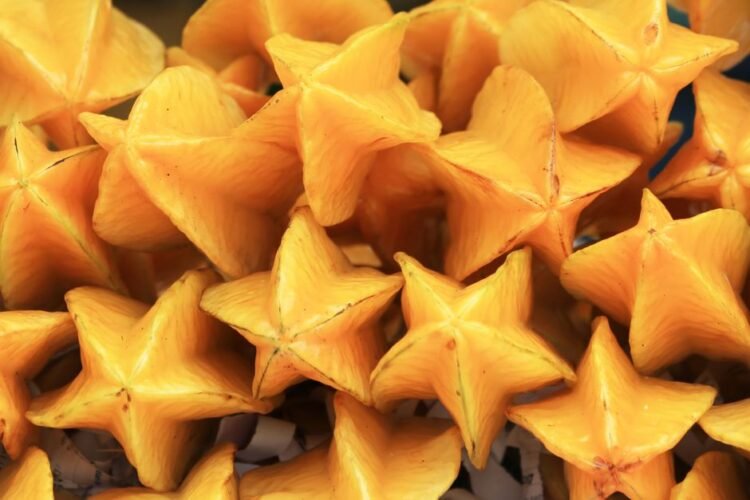
Starfruit, also called carambola, is a translucent yellow, five-angled tropical fruit of the family Oxalidaceae whose crisp, juicy flesh and tart-sweet flavor lend it to both fresh and cooked applications.
CategoryFruits
Scientific nameAverrhoa carambola L.
OriginTropical Southeast Asia, particularly Malaysia, Indonesia, the southern Philippines, and southern China (where it has been cultivated for over 1,000 years).
History & Origins
Cultivated in Malaysia, southern China, and the Malay Archipelago for centuries, starfruit spread to South Asia and the Pacific well before European contact. Portuguese and Spanish traders carried it to the Americas in the 17th–18th centuries, and commercial planting in Florida began in earnest during the late 1800s. Today it is grown commercially across Southeast Asia, Brazil, the Caribbean, and Florida.
Nutrition Facts
Per 100 g, edible portion (estimated)
- 31 kcalCalories
- 1.0 gProtein
- 0.3 gFat
- 6.7 gCarbs
- 2.8 gFiber
- 3.9 gSugars
- 133 mgPotassium
- 34.4 mgVitamin C
- 3 mcgVitamin A
Culinary Uses
- Sliced fresh as a striking star-shaped salad garnish or in rujak
- Blended into chilled juices, smoothies, and the Indian summer cooler bel sharbat
- Pickled with salt, chili, and sugar in Filipino burong balimbing
- Stirred into savory chutneys and sambals to accompany fish and pork
- Cooked briefly as a topping for cheesecakes, tarts, and pavlovas
Known Benefits
- High in vitamin C, supporting immune function and collagen synthesis
- Provides soluble and insoluble fiber for digestive health
- Contains polyphenols such as quercetin and gallic acid with antioxidant activity
- Naturally low in calories and sodium, suiting weight-conscious diets
Hidden Benefits
- Source of lutein and zeaxanthin carotenoids that support retinal health
- Contains ferulic acid and p-coumaric acid studied for anti-inflammatory effects
- Provides non-heme iron alongside vitamin C to enhance plant-based iron absorption


