 (No Ratings Yet)
 Loading...
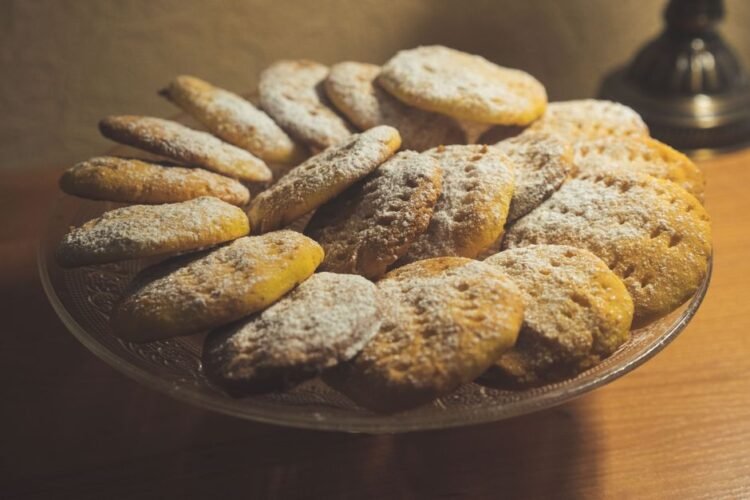
These buttery semolina shortbread cookies are a treasured Syrian specialty, traditionally molded into decorative shapes and filled with a fragrant cinnamon-date paste. Scented with orange blossom and rose water, they are served throughout Eid, Easter, and family celebrations across the Levant.
Prep Time75 mins
Cook Time22 mins
Total Time97 mins
Servings24
Yield24 cookies
Nutrition Facts
Per serving (estimated)
- 175 kcalCalories
- 7 gFat
- 4 gSaturated Fat
- 26 gCarbs
- 2 gFiber
- 13 gSugar
- 2 gProtein
- 30 mgSodium
- 135 mgPotassium
- 22 mgCalcium
- 0.9 mgIron
- 0 mgVitamin C
- 220 mcgVitamin A
Ingredients
For the semolina dough
- 2 cups fine semolina flour
- 1 cup all-purpose flour
- 1 cup (2 sticks) unsalted butter, melted and slightly cooled
- 1/3 cup granulated sugar
- 2 tablespoons orange blossom water
- 1 tablespoon rose water
- 1 teaspoon active dry yeast
- 1/4 cup warm whole milk (about 110 F)
- 1/4 teaspoon fine sea salt
For the date filling
- 2 cups (12 oz) pitted Medjool dates, roughly chopped
- 1 teaspoon ground cinnamon
- 1 tablespoon orange blossom water
- 1 tablespoon unsalted butter
For finishing
- 2 tablespoons powdered sugar, for dusting
Directions
- In a large bowl, whisk together the semolina, flour, sugar, yeast, and salt. Pour in the melted butter and stir with a wooden spoon until the mixture looks like damp sand.
- Add the warm milk, orange blossom water, and rose water. Mix and then knead gently in the bowl for about 5 minutes until a soft, pliable dough forms. Cover with a clean towel and let rest at room temperature for 45 minutes to allow the semolina to soften.
- Meanwhile, make the filling: combine the chopped dates, cinnamon, orange blossom water, and butter in a small saucepan over low heat. Cook for 5 to 7 minutes, mashing with a fork, until the dates break down into a thick, sticky paste. Remove from heat and let cool completely.
- Preheat the oven to 350 F (175 C) and line two baking sheets with parchment paper. If using a traditional maamoul wooden mold, lightly dust the inside with flour; otherwise, prepare a fork for the classic hand-pressed pattern.
- Divide the rested dough into 24 equal pieces (about 30 g each) and roll each into a smooth ball. Divide the date filling into 24 small portions and roll each into a ball as well.
- Press each dough ball into the mold to line the interior, or flatten it into a disc in your palm. Place a date ball in the center, then wrap the dough around it, sealing the filling inside. Press back into the mold and tap firmly to release onto the prepared sheet. If shaping by hand, flatten the filled ball and press a fork pattern across the top.
- Bake the cookies one sheet at a time for 18 to 22 minutes, rotating halfway, until the bottoms are pale golden and the tops are just set and lightly toasted. Do not over-brown.
- Transfer the baked cookies to a wire rack and let cool completely. Dust generously with powdered sugar before serving. Store in an airtight tin at room temperature for up to 2 weeks.
Cook’s Notes
- Fine semolina (not coarse polenta-style) gives the authentic tender-gritty texture; do not substitute with all-purpose flour alone.
- If the dough feels sticky after resting, dust your hands lightly with flour or a little cornstarch when shaping.
- Traditional wooden maamoul molds create the iconic fluted pattern; oiling them very lightly before dusting with flour helps the cookies release cleanly.
- Swap the date filling for finely ground walnuts or pistachios mixed with a tablespoon of sugar and a splash of rose water for variation.
- The dough improves in flavor if made the night before; refrigerate covered and bring back to room temperature before shaping.