 (No Ratings Yet)
 Loading...
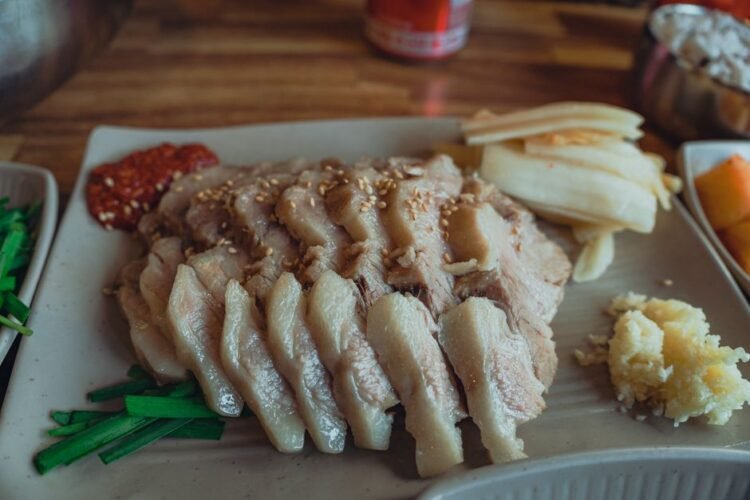
Bossam is a beloved Korean feast featuring tender, thinly sliced steamed pork served with crisp cabbage and lettuce leaves for wrapping. The dish shines with savory-sweet dipping sauces, fresh kimchi, and aromatics that let each diner build their own perfect bite. This classic is ideal for gatherings, pairing rich melt-in-your-mouth pork with bright, acidic condiments.
Prep Time20 mins
Cook Time75 mins
Total Time95 mins
Servings6
Yield6 servings
Nutrition Facts
Per serving (estimated)
- 480 kcalCalories
- 32 gFat
- 11 gSaturated Fat
- 12 gCarbs
- 2 gFiber
- 4 gSugar
- 28 gProtein
- 920 mgSodium
- 580 mgPotassium
- 80 mgCalcium
- 2.5 mgIron
- 18 mgVitamin C
- 150 mcgVitamin A
Ingredients
For the Pork
- 3 lb (1.4 kg) skin-on pork belly or pork shoulder
- 1 large yellow onion, quartered
- 8 cloves garlic, smashed
- 1 inch (2.5 cm) fresh ginger, thinly sliced
For the Braising Liquid
- 8 cups (1.9 L) water
- 1/4 cup (60 ml) Korean rice wine (cheongju)
- 3 tbsp low-sodium soy sauce
- 1 tbsp Korean fish sauce
- 2 tbsp granulated sugar
- 1 tsp whole black peppercorns
- 2 dried bay leaves
- 1 tsp kosher salt
For the Wraps and Table
- 12 napa cabbage leaves, halved lengthwise at the stem
- 1 head red leaf or green leaf lettuce, leaves separated
- 12 perilla leaves (kkaennip), optional
- 1 cup prepared napa cabbage kimchi, cut into bite-size pieces
- 1 cup raw oyster or enoki mushrooms
For the Ssamjang Dipping Sauce
- 3 tbsp Korean doenjang (fermented soybean paste)
- 1 tbsp Korean gochujang (chili paste)
- 1 tbsp toasted sesame oil
- 2 cloves garlic, finely minced
- 1 green onion, thinly sliced
- 1 tsp toasted sesame seeds
Directions
- Place the pork, onion, garlic, and ginger in a large heavy pot and cover with 8 cups cold water. Bring to a boil over high heat, simmer for 10 minutes, then drain and rinse the pork under warm water to remove any scum that has risen to the surface.
- Return the pork to the pot and add the braising liquid ingredients: 8 cups fresh water, rice wine, soy sauce, fish sauce, sugar, peppercorns, bay leaves, and salt.
- Bring the liquid to a gentle boil, then reduce the heat to low, cover, and simmer quietly for 60 to 75 minutes, until a skewer slides easily into the thickest part of the pork with almost no resistance.
- Transfer the pork to a cutting board, tent loosely with foil, and let rest 10 minutes. Slice across the grain into 1/4-inch (6 mm) thick pieces, keeping the skin attached when present.
- While the pork cooks, whisk together the doenjang, gochujang, sesame oil, garlic, green onion, sesame seeds, and 1 tablespoon water in a small bowl until smooth; set the ssamjang sauce aside at room temperature.
- Bring a separate pot of water to a boil and blanch the napa cabbage leaves for 30 seconds until just wilted; immediately transfer to an ice bath, drain, and pat dry with a clean towel.
- Mound the sliced pork on a serving platter and arrange the blanched cabbage, lettuce, perilla leaves, kimchi, and mushrooms in separate sections around it, with the ssamjang sauce in a small bowl in the center.
- To serve, each guest lays a leaf flat, adds a pork slice, a dab of ssamjang, a piece of kimchi, and a few mushrooms, folds the leaf into a tidy bundle, and eats it in one or two flavorful bites.
Cook’s Notes
- For the cleanest slices, refrigerate the cooked pork until fully cool, then cut with a sharp thin-bladed knife and briefly rewarm in the reserved broth before serving.
- Substitute pork shoulder for a leaner bossam; trim excess exterior fat but keep a thin layer for flavor and tenderness.
- Always provide perilla leaves when you can find them; their minty-peppery note is a signature flavor in classic bossam service.
- Lightly sprinkle the blanched cabbage leaves with salt so every wrap carries seasoning through to the pork.
- Save leftover broth for ramen, fried rice, or as a base for kimchi jjigae the next day.