 (No Ratings Yet)
 Loading...
A spongy, slightly tangy fermented flatbread from Ethiopia made traditionally with teff flour. The naturally fermented batter creates the signature honeycomb surface and gentle sourness that makes it the perfect base for scooping stews and curries.
Prep Time15 mins
Cook Time25 mins
Total Time40 mins
Servings4
Yield4 large flatbreads
Nutrition Facts
Per serving (estimated)
- 215 kcalCalories
- 1.5 gFat
- 0.3 gSaturated Fat
- 45 gCarbs
- 5 gFiber
- 0.5 gSugar
- 7 gProtein
- 295 mgSodium
- 300 mgPotassium
- 85 mgCalcium
- 4.2 mgIron
- 0 mgVitamin C
- 0 mcgVitamin A
Ingredients
For the batter
- 2 cups (240 g) whole-grain teff flour
- 2 1/2 cups (600 ml) room-temperature water, divided
- 2 tablespoons all-purpose flour (optional, for structure)
- 1/4 teaspoon active dry yeast (optional, to jump-start fermentation)
- 1/2 teaspoon fine sea salt
For cooking
- Neutral cooking spray or a light brush of oil for the first flatbread only
Directions
- In a large non-reactive bowl, whisk together the teff flour, all-purpose flour, yeast, salt, and 2 cups of the water until completely smooth, then stir in the remaining 1/2 cup water to reach a thin, pourable consistency similar to heavy cream.
- Cover the bowl loosely with a clean kitchen towel (do not seal airtight) and let the batter ferment at room temperature (about 70–75°F) for 2 to 3 days, stirring briefly once a day; it is ready when it smells gently tangy, looks bubbly, and shows tiny fermentation pockets on the surface.
- Stir the fermented batter gently and thin with a few tablespoons of water if it has thickened; the final consistency should coat the back of a spoon but still flow easily when poured.
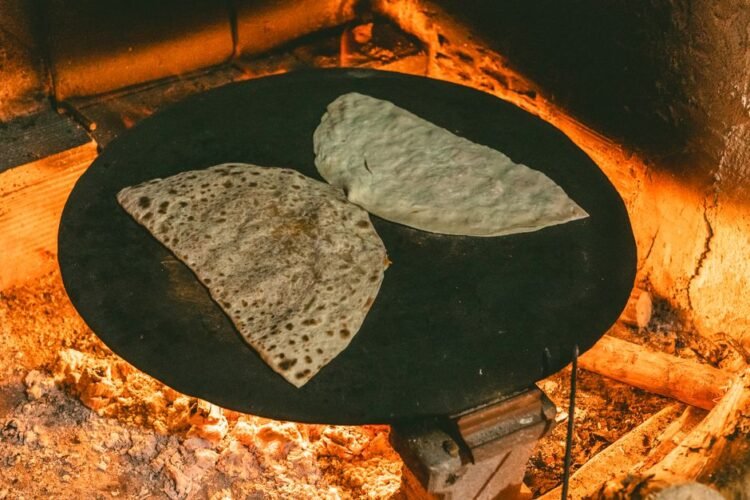
- Heat a 10- or 12-inch non-stick skillet or traditional clay mitad over medium heat for about 2 minutes until evenly hot; lightly grease only for the very first flatbread, then cook the rest dry.
- Pour about 1/2 cup of batter onto the center of the pan in a thin, continuous spiral, swirling immediately so the batter spreads into a thin, even circle about 10 inches across.
- Cover the pan and cook for 1 to 2 minutes, without flipping, until the surface is set, dry to the touch, and covered in tiny open bubbles and a few characteristic larger eyes (holes).
- Slide the flatbread out onto a clean cloth or plate and cover to keep pliable while you repeat with the remaining batter, stacking the cooked flatbreads as you go.
- Serve warm, soft side up, as a base for stews, or rolled with fillings.
Cook’s Notes
- True teff injera is naturally gluten-free; skip the optional all-purpose flour if you need it strictly gluten-free, but expect a slightly more delicate, tear-prone texture.
- Injera is traditionally cooked on a dry, ungreased clay mitad; a well-seasoned non-stick skillet is the closest home substitute and only needs a touch of oil for the very first flatbread.
- Batter thickness is key: too thick yields a pancake-like bread, too thin yields brittle sheets; aim for the consistency of half-and-half cream after fermentation.
- A longer, cooler fermentation produces a more pronounced tang; a warmer, shorter fermentation (24–36 hours at 80°F) yields a milder, slightly sweet flavor.
- Leftover injera can be dried and broken into pieces to use as a sourdough starter for the next batch, or crumbled as a porridge thickener.