 (No Ratings Yet)
 Loading...
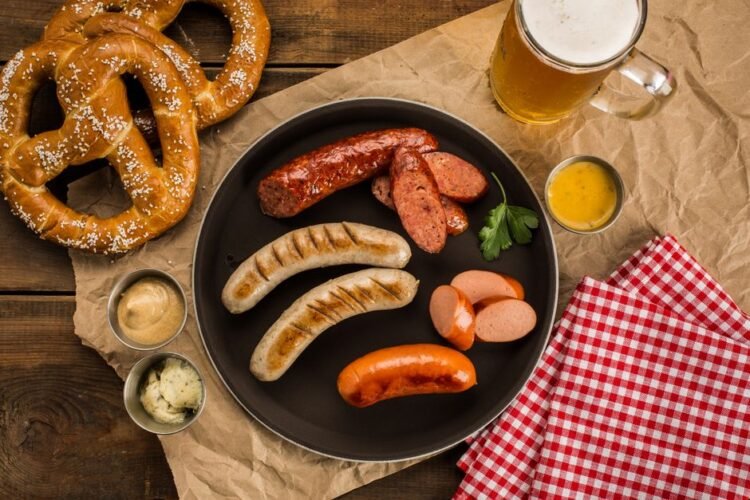
Bavarian White Sausage is a delicate poached sausage from Munich made from finely minced veal, pork, and fresh parsley, seasoned with lemon, mace, and cardamom. Traditionally enjoyed before noon with sweet mustard, soft pretzels, and a cold wheat beer, it is gently poached — never boiled — to keep the pale casing tender and the interior silky.
Prep Time40 mins
Cook Time20 mins
Total Time60 mins
Servings4
Yield4 servings (about 8 sausages)
Nutrition Facts
Per serving (estimated)
- 480 kcalCalories
- 38 gFat
- 14 gSaturated Fat
- 3 gCarbs
- 0 gFiber
- 1 gSugar
- 28 gProtein
- 1180 mgSodium
- 450 mgPotassium
- 40 mgCalcium
- 2.5 mgIron
- 12 mgVitamin C
- 95 mcgVitamin A
Ingredients
For the sausage meat
- 500 g (1.1 lb) veal shoulder, trimmed and cubed
- 250 g (9 oz) pork shoulder, cubed
- 150 g (5 oz) pork back fat, cubed
- 1 small yellow onion, finely grated
- 30 g (1 cup) fresh flat-leaf parsley, finely chopped
- 1 tsp finely grated lemon zest
- 1/2 tsp ground mace
- 1/4 tsp ground ginger
- 1/4 tsp ground cardamom
- 1 tsp ground white pepper
- 1 tbsp fine sea salt
- 100 ml (about 1/3 cup) ice-cold water
- 2 m natural hog casings (24–26 mm), rinsed and soaked
For serving
- 4 soft pretzels (Laugenbrezel)
- 4 tbsp Bavarian sweet mustard (süßer Senf)
- 2 tbsp unsalted butter, softened
Directions
- Chill the cubed veal, pork, and pork back fat in the freezer for 20–30 minutes until very firm but not frozen solid; this is essential for a smooth, emulsified texture.
- Working in batches, pass the chilled veal, pork, and fat through a meat grinder fitted with the finest plate, then transfer to a large bowl set over another bowl of ice. Add the grated onion, parsley, lemon zest, mace, ginger, cardamom, white pepper, and salt, and mix gently by hand until just combined.
- Pour in the ice water a little at a time while kneading and folding the mixture for 3–4 minutes, until it becomes sticky, glossy, and holds together when a small patty is pressed between your fingers. Cover and refrigerate for 30 minutes to let the flavors meld and the mixture firm up.
- Slip the soaked hog casing onto the stuffing tube of a sausage stuffer and pack the meat in tightly, taking care not to trap air bubbles. Tie a knot at the end, then twist or pinch off into 12–14 cm (5–5.5 inch) links, leaving space between each twist.
- Bring a wide pot of unsalted water to 70–75°C (158–167°F) — use a thermometer and keep the heat on low; the water should steam but never boil. Lower the sausages in using a slotted spatula so they do not touch the bottom and poach gently for 15–18 minutes, turning once.
- The sausages are done when they float, feel firm but springy, and the internal temperature reads 72°C (162°F). Lift them out with a slotted spoon onto a warm platter and serve immediately with sweet mustard, soft pretzels, and a small dish of butter for spreading on the pretzel.
Cook’s Notes
- Never boil Weisswurst — temperatures above 80°C (175°F) will cause the casing to burst and the delicate meat emulsion to crumble.
- Traditional Bavarian custom says Weisswurst should be eaten before the noon church bells ring, as older recipes contained no preservatives and would spoil by afternoon.
- Always use very cold meat and ice water; even a small amount of warmth during grinding will break the emulsion and give a grainy texture.
- If you do not have hog casings, the mixture can be formed into small patties (Frikadellen-style) and gently poached, though traditional presentation uses the casing.
- Leftover sausages keep refrigerated for 1 day and are delicious sliced and reheated in a little butter or used in a hearty lentil soup.