 (No Ratings Yet)
 Loading...
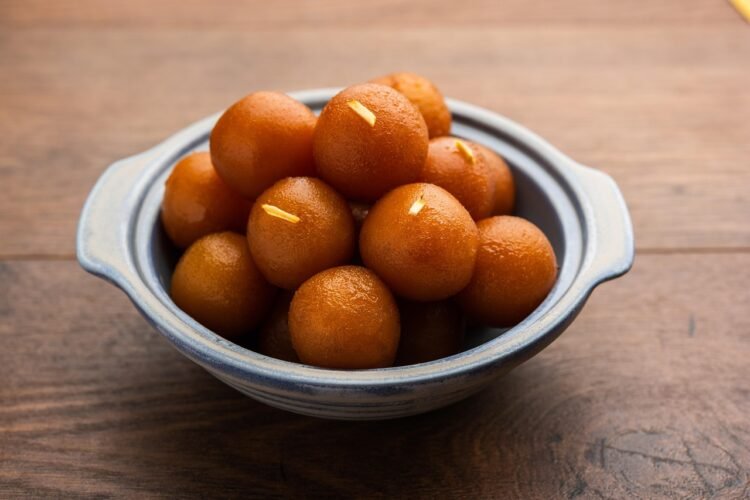
Pantua is the beloved Bengali cousin of gulab jamun, distinguished by its fresh chhena base, a delicate semolina crumb, and a richly flavored khoya-coconut center. These glossy dumplings are gently fried until deep amber, then steeped in warm saffron-cardamom syrup until they swell with sweetness. Each bite offers a tender milky shell, a soft nutty heart, and the floral perfume of saffron.
Prep Time25 mins
Cook Time30 mins
Total Time55 mins
Servings6
Yield6 servings (about 18 dumplings)
Nutrition Facts
Per serving (estimated)
- 380 kcalCalories
- 16 gFat
- 9 gSaturated Fat
- 55 gCarbs
- 1 gFiber
- 42 gSugar
- 7 gProtein
- 85 mgSodium
- 180 mgPotassium
- 220 mgCalcium
- 1 mgIron
- 1 mgVitamin C
- 80 mcgVitamin A
Ingredients
For the dough
- 2 cups fresh chhena or well-drained paneer, crumbled finely
- 3 tablespoons fine semolina (sooji)
- 2 tablespoons all-purpose flour
- 1/4 teaspoon baking powder
- 1/4 teaspoon ground green cardamom
- 1 pinch fine sea salt
For the khoya-coconut filling
- 1/3 cup crumbled khoya (or grated dry coconut, lightly toasted)
- 2 tablespoons powdered sugar
- 1/4 teaspoon ground cardamom
- 1 tablespoon finely chopped pistachios
For the saffron-cardamom syrup
- 2 cups granulated sugar
- 1 1/2 cups water
- 1/2 teaspoon saffron strands, gently crushed
- 4 green cardamom pods, lightly crushed
- 1 teaspoon rose water (optional)
For frying and garnish
- 2 cups ghee or neutral oil, for deep frying
- 1 tablespoon slivered pistachios
- A few saffron strands, to finish
Directions
- Prepare the filling by combining khoya, powdered sugar, cardamom, and pistachios in a small pan; cook over low heat 2-3 minutes until it forms a soft, pliable paste. Cool completely before using.
- Knead the crumbled chhena on a clean surface for 4-5 minutes until smooth and completely free of granules. Add semolina, flour, baking powder, cardamom, and salt; gently bring together into a soft, just-holding dough. Do not overwork.
- Divide the dough into 18 equal portions and roll each into a smooth ball. Flatten lightly between your palms, place about 3/4 teaspoon of filling in the center, enclose, and re-roll into a crack-free ball.
- Heat ghee or oil in a heavy pan to 300°F (150°C). Fry the dumplings in small batches, stirring gently and constantly, for 7-9 minutes until evenly deep golden-brown. They should sizzle very softly, never aggressively.
- Remove with a slotted spoon and drain on paper towels; rest 3 minutes before adding to syrup.
- Meanwhile, make the syrup: simmer sugar and water for 8-10 minutes until slightly sticky between your fingers. Stir in saffron and crushed cardamom pods; keep warm over very low heat.
- Add the warm (not hot) fried Pantua to the warm syrup and let them soak for at least 25-30 minutes, turning once, until they look plump and glossy.
- Warm the syrup with rose water just before serving. Spoon the dumplings into bowls with a generous ladle of syrup and garnish with slivered pistachios and a few saffron strands.
- Serve warm for the silkiest texture, or at room temperature as a festive finish to a Bengali meal.
Cook’s Notes
- Keep frying temperature low and steady; if the oil is too hot the dumplings will darken before the chhena inside cooks through.
- If store-bought paneer is slightly moist, wrap it in cheesecloth and press under a weight for 30 minutes to remove excess whey before crumbling.
- Warm the syrup gently when adding fried Pantua; pouring them into boiling syrup can cause splits or leaks in the dumplings.
- For best flavor, make the Pantua at least 2 hours ahead so the saffron and cardamom fully perfume the chhena.
- Khoya can be swapped with an equal amount of sweetened grated coconut for a coastal Bengali variation.