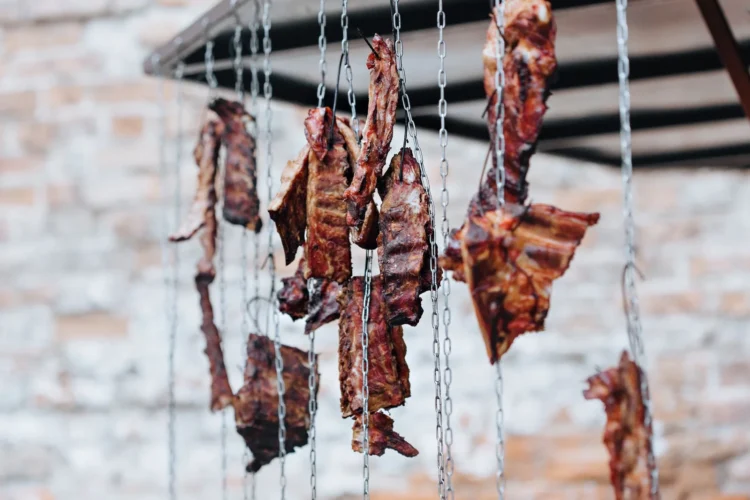
Kilishi is a fiery, chewy dried beef beloved across Northern Nigeria, traditionally prepared by Hausa and Fulani families during the dry harmattan season. Paper-thin beef slices are marinated, brushed with a thick paste of roasted groundnuts and warm spices, then slowly sun-dried until leathery and intensely flavored. It is a high-protein street snack eaten with cold drinks, sliced onion, and tomato, or crumbled over tuwo and hausa koko.
Prep Time30 mins
Cook Time60 mins
Total Time90 mins
Servings6
Yield6 servings (about 300 g dried beef)
Nutrition Facts
Per serving (estimated)
- 285 kcalCalories
- 14 gFat
- 3.5 gSaturated Fat
- 5 gCarbs
- 2 gFiber
- 1 gSugar
- 34 gProtein
- 720 mgSodium
- 480 mgPotassium
- 35 mgCalcium
- 4.5 mgIron
- 2 mgVitamin C
- 95 mcgVitamin A
Ingredients
For the beef and marinade
- 1 kg lean beef (eye of round or top round), trimmed of all visible fat
- 1 tablespoon fine sea salt
- 2 tablespoons freshly grated ginger, divided
- 4 cloves garlic, minced, divided
- 1 teaspoon dried thyme
- 1 teaspoon powdered bouillon
- 1 small onion, grated
For the groundnut-spice paste (yaji)
- 1 cup roasted unsalted groundnuts, finely ground
- 1 tablespoon cayenne pepper (adjust to taste)
- 1 tablespoon sweet paprika
- 1 teaspoon ground cloves
- 1 teaspoon ground cinnamon
- 1/2 teaspoon grated nutmeg
- 4 tablespoons vegetable oil
- 3 tablespoons water, plus more as needed
Directions
- Using a sharp slicing knife, cut the beef against the grain into paper-thin strips about 20 cm long and 3 mm thick; freezing the meat for 30 minutes makes cleaner cuts possible.
- In a large bowl, combine the beef with the salt, half the ginger, half the garlic, thyme, bouillon, and grated onion; massage thoroughly and marinate 1 hour at room temperature or up to 4 hours refrigerated.
- Meanwhile, make the spice paste: blend the ground groundnuts with the remaining ginger, remaining garlic, cayenne, paprika, cloves, cinnamon, nutmeg, oil, and water until a thick, smooth, spreadable paste forms; loosen with a teaspoon of water only if needed.
- Lay each marinated beef strip flat and spread a thin, even layer of the spice paste over the entire surface, pressing gently so it adheres without lumps.
- Arrange coated strips on a wire rack set over a baking sheet, spaced so air circulates; sun-dry outdoors under fine mesh for 6 to 8 hours, or oven-dry at 150°F (65°C) with the convection fan on for 2 to 3 hours, flipping once halfway.
- After 1 hour of drying, brush a second light coat of paste onto any pale spots to deepen color and build the signature crust.
- Test for doneness: properly dried kilishi bends without cracking, feels leathery, and has darkened to a deep mahogany; if still soft, continue drying and check every 30 minutes.
- Optional finish: flash the strips under a hot broiler for 90 seconds to set the crust and add a faint smokiness, watching carefully to prevent scorching.
- Cool completely on the rack, then pack loosely in a paper-lined tin; in dry climates it keeps 2 to 3 weeks at room temperature, longer refrigerated.
- Serve at room temperature with sliced onion, fresh tomato, and a chilled drink, or crumble over tuwo, jollof rice, or hausa koko for an authentic Northern Nigerian plate.
Cook’s Notes
- Slice the beef as thinly as possible; partially freezing makes uniform slices easier and improves drying.
- Use only very lean cuts—any residual fat will not dry and can turn rancid during storage.
- For the most authentic flavor, swap the listed spice blend for a pre-made Hausa yaji (suya spice) mixture.
- In the harmattan dry season, full outdoor sun-drying produces the best color and chewy texture; an oven with convection is the most reliable substitute.
- In humid climates, store finished kilishi in an airtight jar with a food-safe silica packet to prevent mold.
More Nigeria Recipes You’ll Love
Craving more flavors from Nigeria? Try these traditional recipes:
- Classic Nigerian Jollof Rice
- Charred Suya Chicken Thighs with Jollof Rice and Caramelized Plantains
- Smoky Suya-Spiced Chicken with Charred Plantains and Spicy Peanut Relish
You might also like

See this site more often in your Google results.