 (No Ratings Yet)
 Loading...
A beloved Salvadoran street food, these thick griddled corn cakes are stuffed with a savory mashed bean filling and traditionally eaten with curtido cabbage slaw and a bright tomato salsa. The masa dough becomes tender and slightly chewy when cooked on a hot comal, balancing the hearty bean center.
Prep Time25 mins
Cook Time20 mins
Total Time45 mins
Servings4
Yield8 pupusas (4 servings)
Nutrition Facts
Per serving (estimated)
- 380 kcalCalories
- 9 gFat
- 2.5 gSaturated Fat
- 64 gCarbs
- 10 gFiber
- 4 gSugar
- 14 gProtein
- 540 mgSodium
- 680 mgPotassium
- 95 mgCalcium
- 4 mgIron
- 12 mgVitamin C
- 90 mcgVitamin A
Ingredients
For the corn dough
- 2 cups masa harina
- 1 1/2 cups warm water (plus more as needed)
- 1/2 tsp fine salt
- 1 tbsp vegetable oil
- 1 tsp sugar (optional, for browning)
For the bean filling
- 1 1/2 cups cooked red beans, drained well
- 1/4 cup white onion, finely chopped
- 1 garlic clove, minced
- 1 tbsp olive oil
- 1/2 tsp ground cumin
- 1/2 tsp salt
- 1/4 tsp black pepper
- 2 tbsp crumbled queso fresco (optional)
For serving
- 1 cup curtido (fermented cabbage slaw)
- 1/2 cup salsa roja (tomato salsa)
- Lime wedges
Directions
- Make the dough: In a large bowl, whisk the masa harina with the salt and sugar. Pour in the warm water and mix with your hands, adding more water a tablespoon at a time, until a soft, pliable dough forms that does not crack when pressed. Knead briefly, cover, and rest for 10 minutes.
- Make the filling: Warm the olive oil in a skillet over medium heat. Cook the onion until soft and translucent, about 3 minutes. Add the garlic and cook 30 seconds more. Stir in the cooked beans, cumin, salt, and pepper. Mash the mixture with a potato masher until it holds together as a thick paste. Stir in the queso fresco if using, then remove from heat and let cool slightly.
- Shape the pupusas: Keep a small bowl of water nearby to wet your hands. Pinch off a piece of dough about the size of a golf ball and roll it into a smooth ball. Flatten it in your palm into a 1/4-inch-thick disc, keeping the edges slightly thicker than the center.
- Fill and seal: Place about 1 1/2 tablespoons of bean filling in the center of the disc. Fold the dough up around the filling, pinching and rolling to seal it completely so no filling escapes. Gently flatten the ball back into a 1/2-inch-thick disc, smoothing any cracks with a wet fingertip. Repeat with the remaining dough and filling.
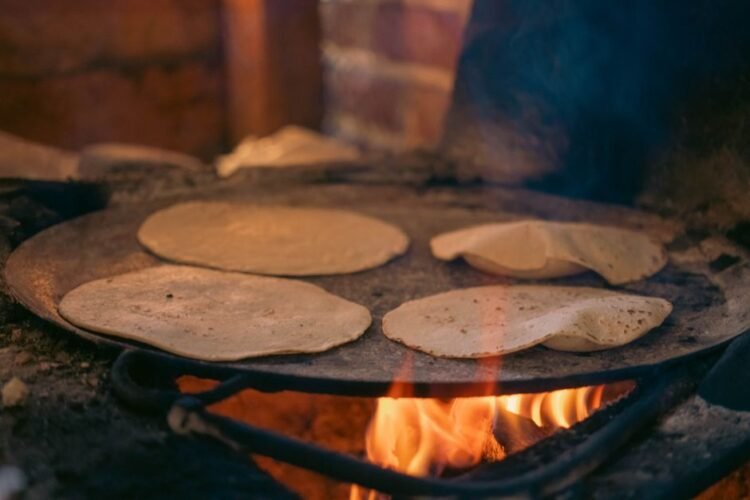
- Cook the pupusas: Heat a comal, cast iron skillet, or heavy non-stick pan over medium heat; do not add oil. Cook the pupusas in batches for about 4 minutes per side, pressing lightly with a spatula, until golden brown spots appear on the surface and the masa is cooked through with a tender interior.
- Serve hot: Stack the cooked pupusas on a plate and cover loosely to keep warm. Serve immediately with a generous spoonful of curtido, salsa roja, and a squeeze of lime.
Cook’s Notes
- The dough should feel like soft modeling clay; if it cracks at the edges when pressed, sprinkle in more warm water one tablespoon at a time until smooth.
- For a more traditional flavor, mix half the filling with a tablespoon of loroco (a Central American herb) or use cooked black beans instead of red beans.
- Always wet your hands before handling the dough to prevent sticking and to help seal the filling inside the pupusa.
- Salvadoran purists cook pupusas on a clay comal for an earthy flavor; a well-seasoned cast iron skillet is the best home substitute.
- Eat pupusas right after cooking for the best texture, as the masa stiffens as it cools; rewarm gently on a dry skillet if needed.