 (No Ratings Yet)
 Loading...
These pillowy, lightly sweet laminated pastries are a cornerstone of Argentine morning culture, traditionally enjoyed alongside a strong coffee or shared over a gourd of mate. Unlike their flakier French cousins, these pastries have a softer, more tender crumb finished with a delicate vanilla glaze that melts into the layers. Eat them plain, split and slathered with dulce de leche, or simply dunked in espresso for an authentic Buenos Aires breakfast.
Prep Time30 mins
Cook Time22 mins
Total Time52 mins
Servings12
Yield12 pastries
Nutrition Facts
Per serving (estimated)
- 270 kcalCalories
- 10 gFat
- 6 gSaturated Fat
- 40 gCarbs
- 1 gFiber
- 14 gSugar
- 6 gProtein
- 195 mgSodium
- 90 mgPotassium
- 50 mgCalcium
- 1.8 mgIron
- 0 mgVitamin C
- 130 mcgVitamin A
Ingredients
For the dough
- 4 cups (500 g) all-purpose flour
- 1 packet (7 g) active dry yeast
- 1/2 cup (100 g) granulated sugar
- 1 tsp fine salt
- 3/4 cup (180 ml) warm whole milk
- 2 large eggs, lightly beaten
- 1 tsp pure vanilla extract
- 1/2 cup (115 g) cold unsalted butter, for laminating
For the glaze and finishing
- 1 large egg, beaten with 1 tbsp milk (for egg wash)
- 1/2 cup (60 g) powdered sugar
- 2 tbsp whole milk
- 1/2 tsp pure vanilla extract
- 2 tbsp melted butter, for brushing
Directions
- In a large bowl, stir the warm milk, yeast, and 1 tablespoon of the sugar together; let stand 5 to 10 minutes until foamy and fragrant.
- Add the flour, remaining sugar, salt, eggs, and vanilla to the yeast mixture. Mix until a shaggy dough forms, then turn out onto a lightly floured surface and knead 8 to 10 minutes until smooth and elastic. Wrap in plastic and refrigerate 1 hour.
- On a floured surface, roll the chilled dough into a 12×8-inch rectangle. Place the cold butter in the center, fold the dough over it like an envelope, and roll out lengthwise. Fold into thirds (like a letter), turn 90 degrees, and repeat the rolling and folding two more times. Chill 30 minutes between each fold.
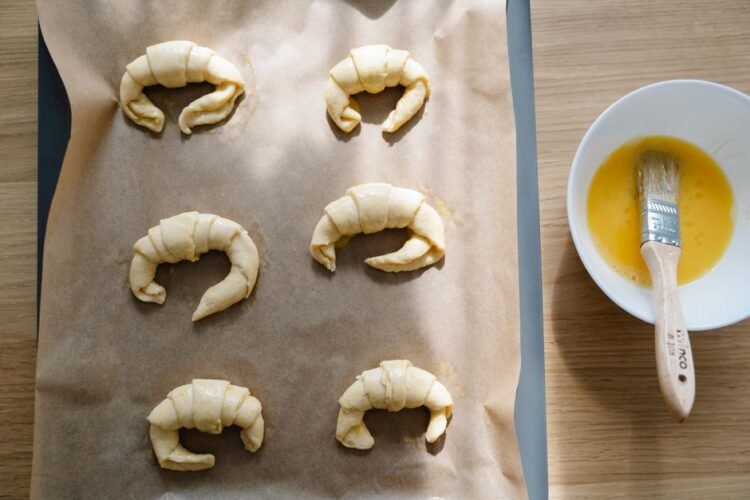
- Roll the final dough 1/4 inch thick and cut into 12 triangles about 4 inches wide. Roll each triangle from base to tip into a crescent, gently stretching the tip underneath.
- Place crescents on parchment-lined baking sheets, leaving 2 inches of space between each. Cover loosely with a kitchen towel and let rise 1 to 1.5 hours at room temperature until visibly puffy.
- Preheat the oven to 375°F (190°C). Brush the risen pastries with egg wash and bake 18 to 22 minutes until deeply golden brown on top and bottom.
- Whisk the powdered sugar, milk, and vanilla into a smooth glaze. Brush the hot pastries with melted butter, then drizzle generously with the vanilla glaze.
- Serve warm or at room temperature. To fill, slice each cooled pastry in half horizontally and pipe in dulce de leche or pastry cream just before serving.
Cook’s Notes
- Keep the butter very cold throughout lamination — if it softens and melts into the dough, you will lose the tender layered texture; chill the dough any time the butter starts feeling greasy.
- For a more traditional Argentine flavor, replace half of the butter with beef or pork lard (grasa); this is how old-school panaderias in Buenos Aires make their facturas.
- Don't skip the 30-minute rests between folds; they relax the gluten and re-chill the butter, which is what gives the pastries their signature soft, layered crumb.
- For an extra glossy finish and subtle sweetness, brush the warm pastries with a light simple syrup (equal parts sugar and water, boiled) before adding the glaze.
- Filled facturas (called 'facturas rellenas') should be filled just before serving so the pastry stays crisp on the edges and doesn't get soggy.