 (No Ratings Yet)
 Loading...
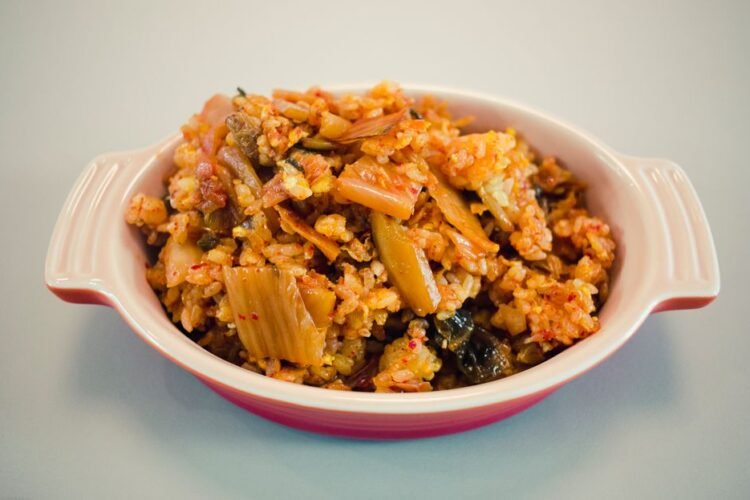
A beloved Korean comfort dish built on day-old rice stir-fried with well-fermented kimchi, diced pork, and a fiery hit of gochugaru. The kimchi caramelizes at the edges while the rice soaks up every drop of tangy, spicy juice for an irresistible weeknight meal.
Prep Time15 mins
Cook Time20 mins
Total Time35 mins
Servings4
Yield4 servings
Nutrition Facts
Per serving (estimated)
- 560 kcalCalories
- 24 gFat
- 7 gSaturated Fat
- 62 gCarbs
- 4 gFiber
- 5 gSugar
- 22 gProtein
- 980 mgSodium
- 480 mgPotassium
- 90 mgCalcium
- 3.5 mgIron
- 18 mgVitamin C
- 180 mcgVitamin A
Ingredients
For the fried rice
- 4 cups cooked short-grain white rice, preferably day-old and cold
- 2 cups well-fermented napa cabbage kimchi, chopped (about 200 g)
- 1/3 cup kimchi juice from the jar
- 200 g pork belly or pork shoulder, diced small
- 1 small yellow onion, finely diced (about 100 g)
- 4 cloves garlic, minced
- 2 tablespoons vegetable oil
- 1 tablespoon butter
- 1 tablespoon soy sauce
- 1 tablespoon gochujang (Korean red pepper paste)
- 2 teaspoons gochugaru (Korean red pepper flakes), plus more to taste
- 2 teaspoons toasted sesame oil
- 3 scallions, thinly sliced (whites and greens separated)
For serving
- 4 large eggs
- 1 sheet toasted nori, cut into thin strips
- 1 teaspoon toasted sesame seeds
- extra sliced scallion greens
Directions
- Prep the rice: break up any clumps of cold rice with damp hands or a fork so the grains separate easily; set aside while you heat a large wok or 12-inch skillet over medium-high heat for 1 minute.
- Cook the pork: add the vegetable oil and diced pork to the hot pan in a single layer. Sear without stirring for 2 minutes to develop a crust, then stir-fry for another 2 to 3 minutes until the pork is browned and renders some fat.
- Sauté aromatics and kimchi: push the pork to one side, add the diced onion to the center, and cook for 2 minutes until softened. Stir in the minced garlic and scallion whites, cooking 30 seconds until fragrant, then add the chopped kimchi and kimchi juice. Stir-fry for 3 to 4 minutes until the kimchi is wilted and just starting to caramelize.
- Season and combine: add the gochujang, gochugaru, and soy sauce directly onto the pork-kimchi mixture and toss to coat. Add the cold rice, breaking up remaining clumps, and stir-fry for 4 to 5 minutes using a scooping motion until every grain is glossy, slightly toasted, and heated through.
- Finish the rice: drizzle the sesame oil over the rice, add the butter and most of the sliced scallion greens, and toss once more for 30 seconds so the butter melts into a silky coating. Taste and adjust with more gochugaru or soy sauce as needed.
- Fry the eggs: wipe out a small nonstick skillet, heat 1 teaspoon oil over medium-high, and fry the eggs sunny-side up for 2 to 3 minutes until the whites are crisp at the edges and the yolks remain runny.
- Serve: divide the kimchi fried rice among 4 bowls, top each with a fried egg, and garnish with nori strips, sesame seeds, and reserved scallion greens. Serve immediately while hot.
Cook’s Notes
- Use day-old cold rice straight from the fridge; freshly cooked rice is too soft and turns mushy when stir-fried.
- The older and more sour your kimchi, the better the flavor; kimchi that is at least 2 to 3 weeks fermented gives the deepest tang and caramelizes beautifully.
- Add 1 teaspoon of sugar if your kimchi is very sour and you want a rounder, sweeter finish to balance the heat.
- For a vegetarian version, skip the pork and use 150 g of diced firm tofu or extra mushrooms; add 1 tablespoon of soy sauce to compensate for the lost savoriness.
- Serve with banchan like quick-pickled radish or steamed bean sprouts to round out the meal.