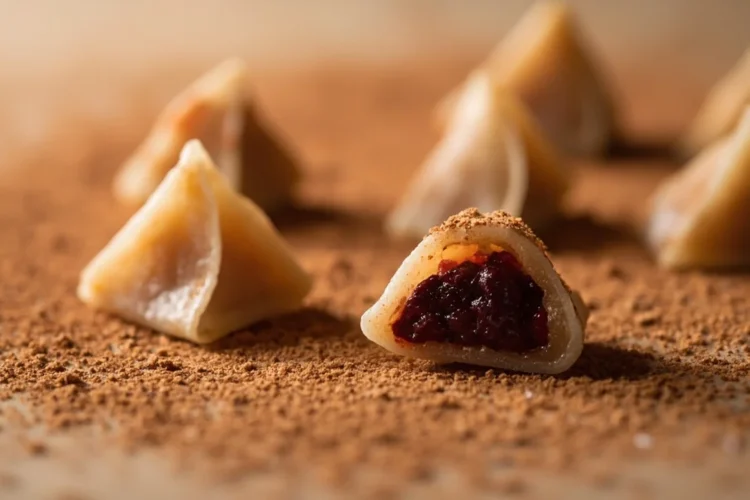
These delicate triangle-shaped confections are a beloved Kyoto specialty, with roots tracing back to the 17th century. The crisp, lightly chewy texture and warming cinnamon flavor pair beautifully with a cup of matcha or green tea for an authentic taste of old Japan.
Prep Time15 mins
Cook Time25 mins
Total Time40 mins
Servings4
Yield8 triangles (4 servings)
Nutrition Facts
Per serving (estimated)
- 175 kcalCalories
- 0.4 gFat
- 0.1 gSaturated Fat
- 41 gCarbs
- 1 gFiber
- 17 gSugar
- 2 gProtein
- 5 mgSodium
- 40 mgPotassium
- 15 mgCalcium
- 0.7 mgIron
- 0 mgVitamin C
- 1 mcgVitamin A
Ingredients
For the dough
- 100 g shiratamako or mochiko (glutinous rice flour)
- 60 g granulated sugar
- 2 tsp ground cinnamon
- 80 ml water
- 1/4 tsp fine salt
For finishing
- 2 tsp ground cinnamon, for dusting
- 1 tbsp granulated sugar, for dusting
Directions
- Preheat the oven to 180°C (350°F) and line a baking sheet with parchment paper.
- In a medium bowl, whisk together the glutinous rice flour, granulated sugar, ground cinnamon, and salt until evenly combined.
- Add the water gradually while mixing with a wooden spoon, then switch to your hands and knead briefly for 1-2 minutes until a smooth, pliable dough forms.
- Place the dough between two large sheets of parchment paper and roll it out into a thin, even sheet about 3 mm (1/8 inch) thick.
- Transfer the rolled dough (still on its parchment) to the prepared baking sheet and bake for 20-25 minutes, until the surface is lightly golden and feels dry to the touch.
- Remove from the oven and let cool on the pan for 2 minutes. Meanwhile, stir together the dusting cinnamon and sugar in a small bowl.
- While the sheet is still warm and flexible, use a sharp knife or pizza cutter to trim the edges and cut it into 8 equal squares, then dust generously with the cinnamon-sugar mixture.
- Fold each square into a triangle by bringing two opposite corners toward the center so they meet in the middle, pressing gently to seal the seam.
- Let the triangles cool completely on a wire rack until crisp, about 10 minutes, then serve with hot matcha or green tea.
Cook’s Notes
- For an authentic chewy 'nama' version, skip the baking and instead wrap small portions of the soft dough around a teaspoon of sweet red bean paste (anko) before folding into triangles.
- Shiratamako gives the smoothest, most elastic dough, but mochiko works well too; do not substitute regular rice flour or the triangles will crumble.
- Roll the dough as evenly as possible so the triangles bake uniformly and crisp up at the same rate.
- Store finished triangles in an airtight container for up to one week; humidity will soften them quickly, so keep them sealed.
- The triangle shape is said to represent the bridge of a Japanese koto harp, a nod to the confection's classical Kyoto origins.
More Japan Recipes You’ll Love
Craving more flavors from Japan? Try these traditional recipes:
- Homemade Sushi Rolls
- Chicken Teriyaki Donburi
- Shoyu-Glazed Pork Belly Bowl with Crispy Shallots and Soft Egg