 (No Ratings Yet)
 Loading...
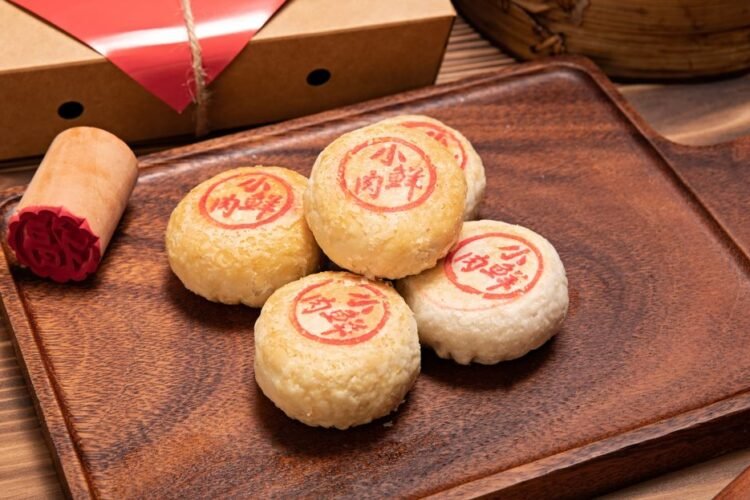
Traditional Chinese mooncakes are iconic pastries enjoyed during the Mid-Autumn Festival, symbolizing family reunion and the full moon. These tender pastries feature a glossy golden crust wrapped around a sweet lotus seed paste filling, often crowned with a salted duck egg yolk representing the moon. Baked in intricately carved wooden molds, they are as beautiful as they are symbolic.
Prep Time45 mins
Cook Time25 mins
Total Time70 mins
Servings8
Yield8 mooncakes (75 g each)
Nutrition Facts
Per serving (estimated)
- 410 kcalCalories
- 16 gFat
- 3 gSaturated Fat
- 60 gCarbs
- 2 gFiber
- 32 gSugar
- 6 gProtein
- 110 mgSodium
- 180 mgPotassium
- 45 mgCalcium
- 1.8 mgIron
- 0.5 mgVitamin C
- 80 mcgVitamin A
Ingredients
For the golden syrup (makes about 1 cup; prepare in advance)
- 2 cups (400 g) granulated sugar
- 1 cup (240 ml) water
- 2 tablespoons fresh lemon juice or 1/4 teaspoon cream of tartar
For the mooncake dough
- 100 g prepared golden syrup
- 1/2 teaspoon lye water (kansui)
- 30 ml neutral vegetable oil
- 150 g cake flour, sifted
- 1/2 teaspoon baking soda (if lye water unavailable)
For the filling and assembly
- 400 g smooth lotus seed paste (store-bought or homemade)
- 4 salted duck egg yolks, halved
- 1 tablespoon melon seeds or toasted sesame seeds (optional)
- Plain flour for dusting the mold
For the egg wash
- 1 large egg yolk
- 1 tablespoon water
- 1/4 teaspoon fine salt
Directions
- If making golden syrup from scratch, combine sugar, water, and lemon juice in a heavy saucepan. Bring to a gentle boil over medium heat, stirring until sugar dissolves, then simmer uncovered for 40-50 minutes without stirring until the syrup turns amber and thickens slightly; cool completely before using.
- In a large bowl, whisk the cooled golden syrup with lye water and vegetable oil until well combined. Add the sifted cake flour all at once and stir with a spatula, then gently knead by hand just until a soft, non-sticky dough forms; do not overwork. Cover with plastic wrap and rest at room temperature for at least 2 hours, or refrigerate overnight.
- Divide the lotus paste into 8 equal portions of about 50 g each. Roll each portion into a smooth ball, then flatten slightly and wrap a salted egg yolk half in the center along with a few melon seeds if using; roll back into a smooth ball.
- Divide the rested dough into 8 equal pieces of about 22 g each. Lightly dust a work surface with flour and roll each dough piece into a thin round about 10 cm in diameter, keeping the edges slightly thinner than the center.
- Place one filling ball in the center of a dough round, gently push the dough up and around the filling, and pinch firmly to seal. Lightly dust the mooncake mold with flour, place the ball seam-side up inside, press firmly, then tap the mold to release the patterned mooncake onto a parchment-lined baking sheet.
- Preheat the oven to 180°C (350°F). Lightly spray or mist the molded mooncakes with water and bake for 8 minutes to set the surface. Meanwhile, whisk the egg yolk with water and salt, then strain through a fine sieve.
- Remove the mooncakes from the oven and let cool for 5 minutes. Brush a very thin, even layer of egg wash over the tops and sides, avoiding pooling in the patterns. Return to the oven and bake another 10-12 minutes until the crust is deep golden brown.
- Transfer the mooncakes to a wire rack and let cool completely. Store in an airtight container at room temperature for 24-48 hours before eating; this resting time allows the golden syrup crust to soften, develop its characteristic glossy sheen, and become tender.
- Serve at room temperature, traditionally with Chinese tea such as pu-erh or jasmine, during Mid-Autumn Festival gatherings or as a sweet treat year-round.
Cook’s Notes
- Lye water (kansui) is essential for the traditional golden color and alkaline flavor; substitute with 1/2 teaspoon baking soda dissolved in 1 teaspoon water if unavailable, though the crust will be slightly less authentic.
- Golden syrup improves with age; make it at least 1 day ahead and store in a clean jar at room temperature for deeper flavor and color.
- Do not overwork the dough or the crust will be tough; knead only until the flour is just incorporated.
- Apply egg wash in a very thin, even layer; too much will obscure the molded patterns and cause the crust to crack during baking.
- Allow baked mooncakes to rest 1-2 days in an airtight container before serving; the crust transforms from crisp to soft and glossy as the syrup absorbs moisture from the filling.