 (No Ratings Yet)
 Loading...
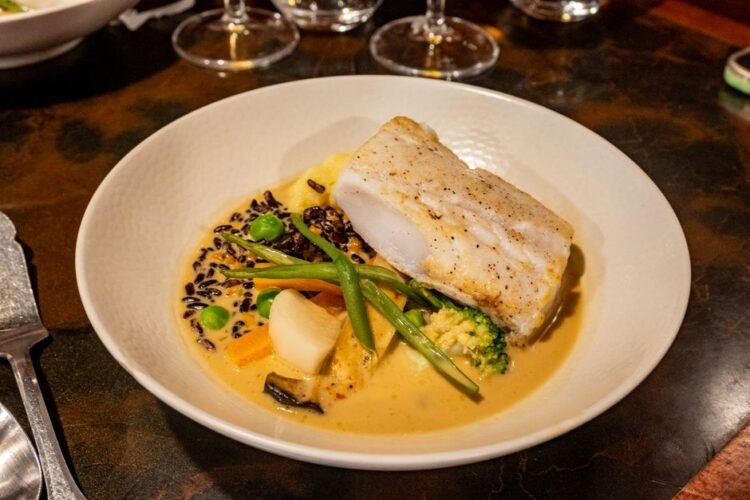
Turbot with Hollandaise is a hallmark of refined French cuisine, pairing the delicate, sweet flesh of poached turbot with a silky, butter-rich hollandaise. Gentle poaching keeps the fish moist and tender, while the warm sauce adds richness without overwhelming the turbot's subtle flavor. Served simply with fresh herbs and lemon, it lets both star ingredients shine.
Prep Time15 mins
Cook Time25 mins
Total Time40 mins
Servings4
Yield4 servings
Nutrition Facts
Per serving (estimated)
- 470 kcalCalories
- 36 gFat
- 20 gSaturated Fat
- 2 gCarbs
- 0 gFiber
- 1 gSugar
- 29 gProtein
- 410 mgSodium
- 430 mgPotassium
- 80 mgCalcium
- 1.4 mgIron
- 6 mgVitamin C
- 340 mcgVitamin A
Ingredients
For the Court Bouillon
- 4 cups water
- 1 cup dry white wine
- 1 lemon, thinly sliced
- 1 small onion, thinly sliced
- 2 bay leaves
- 6 whole black peppercorns
- 1 tbsp sea salt
For the Turbot
- 4 turbot fillets (about 6 oz / 170 g each), skin on if possible
- Fine sea salt, to taste
- Freshly ground white pepper, to taste
For the Hollandaise
- 3 large egg yolks
- 1 tbsp fresh lemon juice
- 1 tbsp warm water
- 12 tbsp unsalted butter, melted and clarified
- Pinch of cayenne pepper
- Pinch of fine sea salt
For the Garnish
- 2 tbsp fresh chives, finely snipped
- 1 tbsp fresh tarragon, chopped
- Lemon wedges, for serving
Directions
- Prepare the court bouillon: In a wide, shallow pan, combine the water, wine, lemon, onion, bay leaves, peppercorns, and salt. Bring to a gentle simmer over medium heat and cook for 10 minutes to infuse the liquid.
- Season the turbot fillets lightly with salt and white pepper on both sides. Lower the heat so the court bouillon is barely steaming at about 170°F / 75°C.
- Slip the turbot fillets into the liquid skin-side up (if skin-on) and poach gently for 6 to 8 minutes, until the flesh is opaque and flakes easily when tested with a fork at the thickest part.
- Meanwhile, make the hollandaise: Set a heatproof bowl over a pan of barely simmering water (do not let the bowl touch the water) and whisk the egg yolks with the lemon juice and warm water until pale, airy, and slightly thickened, about 2 minutes.
- Slowly drizzle in the clarified butter in a thin, steady stream, whisking constantly, until the sauce is thick, glossy, and fully emulsified. Remove from the heat and season with cayenne and salt. Keep warm, stirring occasionally.
- Using a slotted fish spatula, lift each turbot fillet from the court bouillon, drain briefly, and transfer to warmed plates. Pat gently with paper towels to remove excess moisture.
- Spoon the hollandaise generously over each fillet, allowing some to pool on the plate.
- Sprinkle with chives and tarragon and serve immediately with lemon wedges, alongside steamed baby potatoes or lightly buttered asparagus if desired.
Cook’s Notes
- Clarifying the butter removes milk solids that can cause the sauce to break; melt gently, skim off the foam, and pour off the clear fat, leaving the white solids behind.
- If the hollandaise thickens too much while waiting, whisk in a teaspoon of warm water to loosen; if it breaks, start a fresh yolk in a clean bowl and slowly whisk the broken sauce into it to re-emulsify.
- A whole turbot (about 2 lb / 900 g) can be substituted for fillets — steam on the bone for 18–22 minutes, then 8 minutes flesh-side up, and carve at the table.
- Brill or Dover sole are excellent stand-ins for turbot; reduce poaching time to 4–5 minutes for thinner fillets.