 (No Ratings Yet)
 Loading...
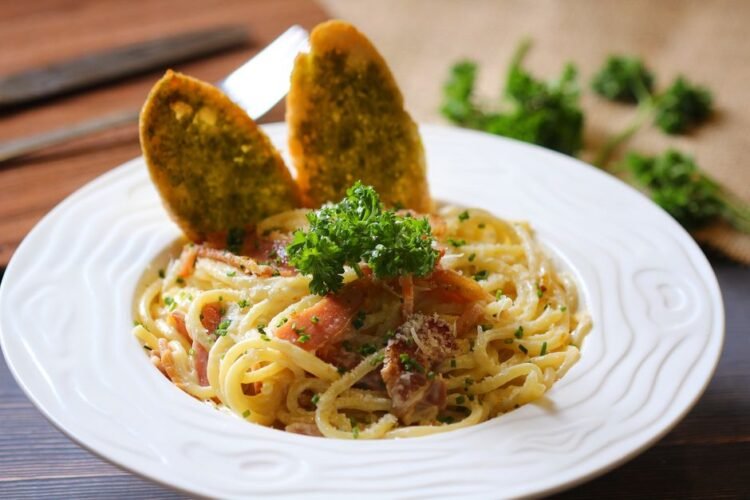
A true Roman street-food classic, Spaghetti alla Carbonara is a study in restraint: rendered guanciale, beaten eggs, sharp Pecorino Romano, and a heavy hand of cracked black pepper tossed together off the heat to form a glossy, silky sauce that clings to each strand. There is no cream, no garlic, and no Parmesan—this is pasta the way it has been made in the trattorie of Rome for generations.
Prep Time10 mins
Cook Time20 mins
Total Time30 mins
Servings4
Yield4 servings
Nutrition Facts
Per serving (estimated)
- 620 kcalCalories
- 28 gFat
- 10 gSaturated Fat
- 62 gCarbs
- 3 gFiber
- 1 gSugar
- 28 gProtein
- 720 mgSodium
- 280 mgPotassium
- 190 mgCalcium
- 3 mgIron
- 0 mgVitamin C
- 120 mcgVitamin A
Ingredients
For the pasta
- 400 g (about 14 oz) spaghetti or tonnarelli
- 30 g coarse sea salt for the boiling water
For the sauce
- 150 g (about 5 oz) guanciale, cut into matchsticks or small dice
- 3 large egg yolks
- 1 whole large egg
- 80 g (about 1 cup) Pecorino Romano, finely grated, plus extra to serve
- 2 tsp freshly cracked black pepper, plus more for finishing
Directions
- Bring 4 liters of water to a rolling boil, add the salt, and cook the spaghetti until just shy of al dente, about 1 minute less than the package directions. Reserve 1 cup of the starchy cooking water before draining.
- While the pasta cooks, place the guanciale in a cold, wide skillet (not nonstick) set over medium-low heat. Render slowly until the fat is liquid gold and the pieces are crisp on the edges, about 7-8 minutes. Remove from the heat; do not drain the fat.
- In a medium bowl, whisk the egg yolks and whole egg together with the grated Pecorino Romano and 1 teaspoon of cracked black pepper until you have a thick, sandy paste. Loosen with 2 tablespoons of the reserved pasta water until smooth and pourable.
- Add the drained pasta to the skillet with the warm guanciale and fat, tossing over low heat for 30 seconds to coat. Pull the skillet off the heat entirely—this step is critical to keep the eggs from scrambling.
- Pour the egg-and-cheese mixture over the pasta and toss vigorously with tongs, adding more reserved pasta water a splash at a time as needed, until a creamy, glossy sauce forms that coats every strand. If the pan is too hot, transfer everything to a large bowl and toss there instead.
- Plate immediately, shower with extra Pecorino Romano, and grind more black pepper over the top. Serve at once while molten and silky—carbonara waits for no one.
Cook’s Notes
- Use guanciale (cured pork jowl) for the most authentic flavor—pancetta works in a pinch but lacks the same aromatic intensity, and bacon will make the dish smoky rather than savory.
- Mix the eggs and cheese only at room temperature, never cold straight from the fridge, so they emulsify smoothly with the hot pasta.
- Always combine the eggs with the pasta off direct heat; residual warmth from the skillet and noodles is enough to cook the sauce gently without scrambling.
- The starchy pasta water is essential—its glutens help suspend the cheese and egg into a true sauce, so always reserve more than you think you'll need.
- Eat carbonara the moment it is plated. Letting it sit causes the sauce to seize and the noodles to clump; this is a dish built for speed.