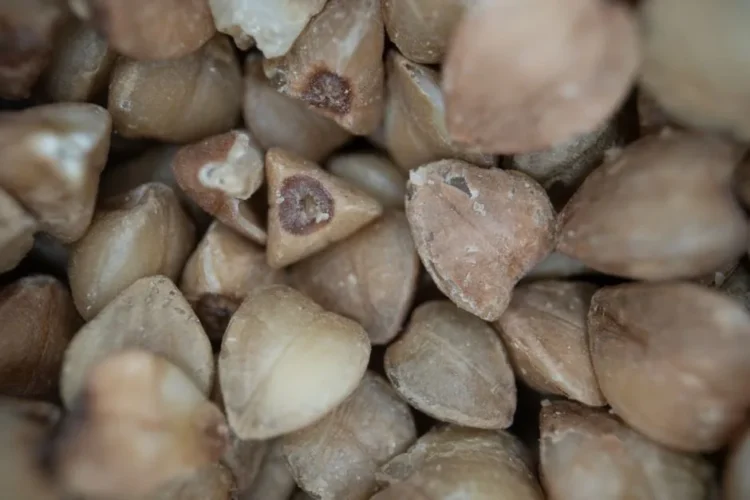
Buckwheat is a gluten-free starchy pseudocereal whose triangular seeds (groats) are cooked as a grain or milled into flour. Despite its name, it is botanically unrelated to wheat and belongs to the Polygonaceae knotweed family.
History & Origins
Buckwheat was domesticated in southwestern China, particularly the Yunnan region, between 6,000 and 8,000 years ago, where it was cultivated alongside millet by early farming cultures. It spread westward along Silk Road and steppe trade routes through Central Asia, reaching the Balkans and Eastern Europe by the medieval period, where it became a dietary staple in Slavic countries (Russian kasha, Polish kasza) and in the Brittany region of France. Despite being later displaced by true cereals in many regions, buckwheat has experienced a global revival since the late twentieth century due to its gluten-free status and dense micronutrient profile.
Nutrition Facts
Per 100 g, edible portion (estimated)
- 343 kcalCalories
- 13.3 gProtein
- 3.4 gFat
- 71.5 gCarbs
- 10.0 gFiber
- 0.9 gSugars
- 460 mgPotassium
- 2.2 mgIron
- 231 mgMagnesium
Culinary Uses
- Toasted kasha served as a porridge or pilaf in Russian, Polish, and Ukrainian cuisines
- Japanese soba noodles made from buckwheat flour, often blended with wheat flour
- Thin Breton galettes (sarrasin) and Russian blini made from buckwheat batter
- Italian pizzoccheri pasta and Alpine polenta taragna
- Buckwheat flour in gluten-free breads, crepes, and Korean memil-muk jelly cakes
Known Benefits
- Naturally gluten-free, suitable for celiac diets when uncontaminated
- Complete protein providing all nine essential amino acids, unusually high for a grain
- Rich source of magnesium, manganese, and the bioflavonoid rutin
- Supports cardiovascular health and healthy blood pressure
- High dietary fiber content aids digestion and satiety
Hidden Benefits
- Contains D-chiro-inositol, a compound shown to improve insulin sensitivity and benefit women with PCOS
- Resistant starch in cooled cooked groats feeds beneficial gut microbiota
- Provides fagopyritols, unique sugars with potential anti-diabetic effects
- Lignans and phenolic compounds offer antioxidant activity rivaling berries
Cautions & Considerations
- Buckwheat contains fagopyrin, a photosensitizing pigment; excessive raw consumption may cause skin photosensitivity in livestock and sensitive individuals
- Buckwheat allergy is well-documented and can be severe, sometimes cross-reacting with latex or rice
- Gluten-free certification required for celiacs, as buckwheat is often processed alongside wheat
- Contains oxalates, which may concern individuals with a history of kidney stones