 (No Ratings Yet)
 Loading...
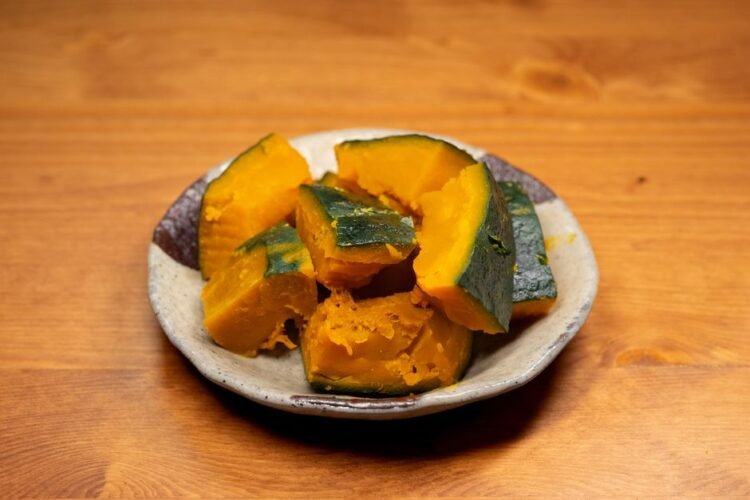
A beloved home-style Japanese side dish, tender kabocha squash wedges are gently simmered in a savory-sweet broth of dashi, soy sauce, and mirin until the liquid reduces to a glossy glaze. The squash becomes buttery-soft while the skin stays intact, soaking up every drop of umami-rich flavor.
Prep Time10 mins
Cook Time25 mins
Total Time35 mins
Servings4
Yield4 side-dish servings
Nutrition Facts
Per serving (estimated)
- 135 kcalCalories
- 4 gFat
- 0.5 gSaturated Fat
- 22 gCarbs
- 3 gFiber
- 12 gSugar
- 4 gProtein
- 780 mgSodium
- 620 mgPotassium
- 40 mgCalcium
- 1.2 mgIron
- 18 mgVitamin C
- 840 mcgVitamin A
Ingredients
For the squash
- 1 small kabocha squash (about 2 lb / 900 g)
- 1 tablespoon neutral oil
For the simmering broth
- 2 cups dashi (or 2 cups water + 1 teaspoon dashi powder)
- 3 tablespoons soy sauce
- 2 tablespoons mirin
- 1 tablespoon sake
- 1 1/2 tablespoons granulated sugar
- 1/4 teaspoon fine salt
Optional garnish
- 1 tablespoon katsuobushi (bonito flakes)
- 1 teaspoon toasted sesame seeds
Directions
- Wash the kabocha squash thoroughly and pat dry. Place it stem-up on a sturdy cutting board and use a sharp, heavy knife to cut it in half, then scoop out the fibrous seeds and stringy pulp with a spoon.
- Cut each half into 1 1/2-inch-wide wedges; the skin is edible and helps the wedges hold their shape, so leave it on. If the squash feels tough, microwave the whole squash for 2 minutes to soften it slightly before cutting.
- In a heavy-bottomed pot or donabe, whisk together the dashi, soy sauce, mirin, sake, sugar, and salt. Add the squash wedges in a single layer, skin-side down if possible.
- Bring the liquid to a boil over medium-high heat. Once boiling, reduce the heat to medium-low, cover with a tight-fitting lid, and simmer gently for 12 minutes without stirring so the wedges keep their shape.
- Uncover and baste the wedges with the broth. Continue to simmer uncovered for 8 to 10 minutes more, occasionally spooning the liquid over the tops, until the squash is fork-tender and the broth has reduced to a thick, glossy glaze that coats the bottom of the pot.
- If the squash is tender but the liquid is still thin, increase the heat slightly for the final 1 to 2 minutes to speed up reduction. Be careful not to overcook or the wedges will crumble.
- Transfer the simmered kabocha to a shallow serving plate, spoon any remaining glaze over the top, and finish with bonito flakes and toasted sesame seeds. Serve warm or at room temperature as part of a traditional Japanese meal.
Cook’s Notes
- Choose a kabocha that feels heavy for its size and has a deep, matte-green skin with a dry, brown stem — these signs indicate a sweet, mature squash.
- For a vegetarian or vegan version, swap the dashi for a kombu-only or shiitake-soaked dashi and skip the bonito flake garnish.
- Resist the urge to stir the wedges during the initial covered simmer; this keeps the soft flesh from breaking apart and falling into the sauce.
- If using a Japanese pumpkin or buttercup squash as a substitute, reduce the simmering time by 2 to 3 minutes since they tend to cook faster than kabocha.
- Leftovers keep well refrigerated for up to 3 days and taste even better the next day as the flavors continue to meld — reheat gently with a splash of water.