 (No Ratings Yet)
 Loading...
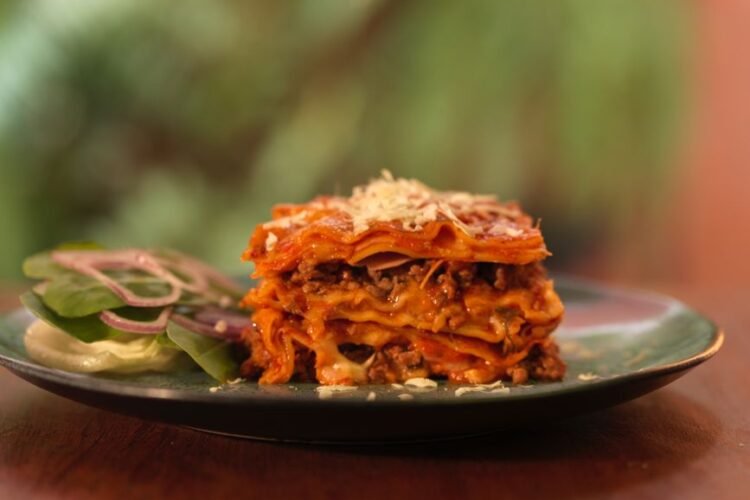
This is the definitive Italian-American-leaning Sunday lasagna: thin pasta sheets layered with a slow-simmered mixed-meat ragù, a silken nutmeg béchamel, and plenty of aged Parmigiano-Reggiano. It bakes until the top is bronzed and bubbling, then rests so every slice holds together cleanly.
Prep Time35 mins
Cook Time115 mins
Total Time150 mins
Servings8
Yield8 generous servings
Nutrition Facts
Per serving (estimated)
- 640 kcalCalories
- 30 gFat
- 14 gSaturated Fat
- 52 gCarbs
- 4 gFiber
- 11 gSugar
- 38 gProtein
- 880 mgSodium
- 760 mgPotassium
- 460 mgCalcium
- 4 mgIron
- 13 mgVitamin C
- 210 mcgVitamin A
Ingredients
For the meat ragù (Bolognese-style)
- 3 tbsp extra-virgin olive oil
- 1 medium yellow onion, finely diced
- 1 medium carrot, finely diced
- 2 celery stalks, finely diced
- 4 garlic cloves, minced
- 8 oz ground beef chuck (80/20)
- 8 oz ground pork
- 1/2 cup dry red wine
- 2 tbsp double-concentrated tomato paste
- 28 oz can San Marzano plum tomatoes, crushed by hand
- 1/2 cup whole milk
- 1 1/2 tsp kosher salt, plus more to taste
- 1/2 tsp freshly ground black pepper
- 1 small bay leaf
For the béchamel sauce
- 6 tbsp unsalted butter
- 6 tbsp all-purpose flour
- 4 cups whole milk, warmed
- 1/4 tsp freshly grated nutmeg
- 3/4 tsp kosher salt
- 1/4 tsp white pepper
For assembling and finishing
- 12 lasagna sheets (no-boil or fresh egg pasta)
- 1 1/2 cups finely grated Parmigiano-Reggiano (about 4 oz)
- 8 oz low-moisture mozzarella, torn into small pieces
- 2 tbsp chopped fresh flat-leaf parsley
Directions
- Heat the olive oil in a heavy Dutch oven over medium heat. Add the onion, carrot, and celery and cook gently for 8 to 10 minutes, until softened and lightly golden at the edges.
- Stir in the garlic and cook 1 minute. Increase the heat to medium-high, add the beef and pork, and break the meat up with a wooden spoon; brown for 8 to 10 minutes until no pink remains.
- Pour in the red wine and simmer until almost completely evaporated, 3 to 4 minutes. Stir in the tomato paste and cook 2 minutes to deepen its flavor.
- Add the crushed tomatoes, milk, salt, pepper, and bay leaf. Bring to a gentle simmer, then reduce the heat to low and cook uncovered for 75 to 90 minutes, stirring every 10 minutes, until the ragù is thick, glossy, and richly colored. Discard the bay leaf.
- Make the béchamel: melt the butter in a medium saucepan over medium heat. Whisk in the flour and cook 1 to 2 minutes until pale blonde. Slowly whisk in the warm milk and bring to a simmer, whisking constantly, until the sauce thickens enough to coat the back of a spoon, 5 to 7 minutes. Season with the nutmeg, salt, and white pepper.
- Position a rack in the center of the oven and preheat to 375°F (190°C). Butter a 9×13-inch baking dish. Spread a thin layer of ragù (about 3/4 cup) over the bottom of the dish.
- Build the lasagna in 4 to 5 layers: a single layer of pasta sheets, one-third of the remaining ragù, one-third of the béchamel, a generous sprinkle of Parmigiano, and a scattering of mozzarella. Repeat, ending with a final layer of béchamel topped with the remaining Parmigiano and mozzarella.
- Cover the dish tightly with foil and bake for 25 minutes. Remove the foil and continue baking 25 to 30 minutes more, until the top is deeply golden brown and the sauce bubbles at the edges.
- Let the lasagna rest on a wire rack for at least 15 minutes (this step is non-negotiable for clean slices). Scatter with the chopped parsley, cut into squares, and serve hot.
Cook’s Notes
- Make the ragù up to 2 days ahead and refrigerate; the flavor actually deepens overnight and the fat solidifies for easier skimming.
- If using traditional dried lasagna sheets, boil them in well-salted water for 4 to 5 minutes until just pliable, then drain and lay flat on an oiled sheet pan to prevent sticking.
- Always let the lasagna rest at least 15 minutes before slicing, otherwise the layers will slide and you'll lose the architecture.
- Grate the Parmigiano-Reggiano finely by hand; pre-shredded cheese contains anti-caking agents that prevent smooth melting.
- For an even richer ragù, finely dice 2 ounces of pancetta and render it as the first step, using the fat in place of some of the olive oil.
You might also like
European
Pumpkin and Taleggio Baked Rigatoni with Amaretti Crumble and Sage Brown Butter
European
Lemon-Herb Baked Cod with Cherry Tomato-Olive Relish over Saffron Orzo
Desserts
Pistachio and Orange Blossom Olive Oil Cake with Whipped Mascarpone
European