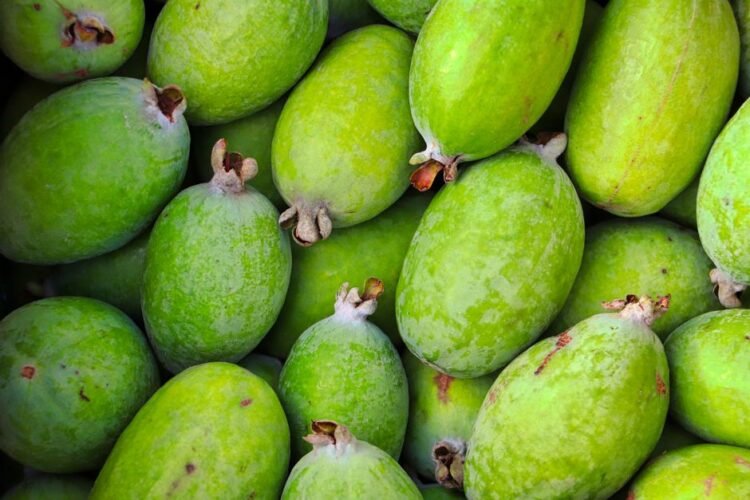
Feijoa is a versatile evergreen fruit with a distinctive flavor combining notes of pineapple, guava, and mint, primarily cultivated in New Zealand, Australia, and parts of South America and Europe.
History & Origins
Feijoa was first described by botanist Otto Kuntze in 1898, naming it after Portuguese botanist João da Silva Feijó. The fruit remained relatively obscure outside its native South American range until the early 20th century. New Zealand became the primary commercial producer beginning in the 1920s, where it naturalized successfully and became widely cultivated. Today, New Zealand remains the world's largest exporter, with significant production in Australia, parts of the Caucasus region (Georgia), and California's Central Coast.
Nutrition Facts
Per 100 g, edible portion (estimated)
- 60 kcalCalories
- 83 gWater
- 0.8 gProtein
- 0.4 gFat
- 0.1 gSaturated Fat
- 15 gCarbs
- 1.6 gFiber
- 14 gSugars
- 168 mgPotassium
- 11 mgCalcium
- 0.2 mgIron
- 10 mgMagnesium
- 36 mgVitamin C
- 54 mcgVitamin A
- 4 mcgVitamin K
- 43 mcgFolate
Culinary Uses
- Eaten fresh by halving the fruit and scooping out the creamy flesh with a spoon
- Processed into jams, jellies, and fruit preserves
- Used in baking as a flavoring for cakes, muffins, and tarts
- Blended into smoothies, juices, and cocktails
- Made into liqueurs and spirits in New Zealand
- Added to salads for a tropical note
Known Benefits
- High in vitamin C, providing over 40% of daily requirements per 100g serving
- Contains dietary fiber supporting digestive health
- Rich in antioxidants including vitamin A
- Good source of potassium for cardiovascular health
- Low in calories and fat while being satisfyingly sweet
Hidden Benefits
- Contains foliate important for cell division and DNA synthesis
- Provides magnesium supporting muscle and nerve function
- Contains small amounts of copper necessary for iron metabolism
- The leaves contain tannins that have been used in traditional medicine
- Contains unique volatile compounds contributing to its distinctive aroma profile
Cautions & Considerations
- May cause allergic reactions in individuals sensitive to other Myrtaceae family fruits
- The high sugar content makes it unsuitable for strict low-sugar diets in large quantities
- Seeds may pose a choking hazard if consumed whole in large amounts
- Unripe feijoas have an astringent taste and may cause mild stomach discomfort
- Some individuals may experience oral allergy syndrome when consuming raw fruit