 (No Ratings Yet)
 Loading...
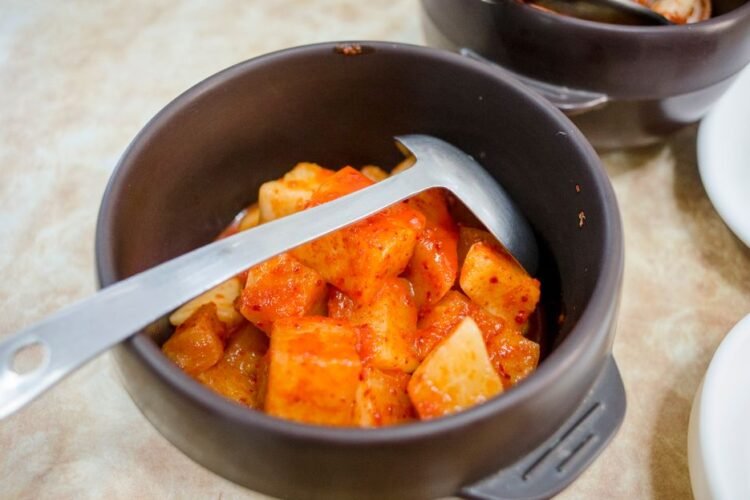
Crisp, refreshingly spicy, and lightly tangy, this classic cubed Korean radish kimchi is one of Korea's most beloved banchan. Made by salting crunchy mu radish and tossing it with a fiery gochugaru paste, it develops deep flavor after a day of fermentation. Serve cold alongside steamed rice, grilled meats, or hearty stews.
Prep Time40 mins
Cook Time0 mins
Total Time40 mins
Servings6
Yield6 servings (about 6 cups)
Nutrition Facts
Per serving (estimated)
- 65 kcalCalories
- 0.5 gFat
- 0 gSaturated Fat
- 13 gCarbs
- 4 gFiber
- 5 gSugar
- 3 gProtein
- 1280 mgSodium
- 410 mgPotassium
- 65 mgCalcium
- 1.2 mgIron
- 26 mgVitamin C
- 55 mcgVitamin A
Ingredients
For the radish and aromatics
- 1 (2 1/2 lb / 1.1 kg) Korean radish (mu), peeled
- 1/4 cup (60 g) coarse Korean sea salt
- 4 cups (960 ml) cold water, for soaking
- 2 scallions, trimmed and thinly sliced (whites and greens kept separate)
For the seasoning paste
- 1/3 cup Korean chili powder (gochugaru)
- 1/4 cup fish sauce
- 1 tbsp saeujeot (salted shrimp), finely minced
- 8 cloves garlic, finely grated
- 1 tbsp fresh ginger, finely grated
- 1 tbsp granulated sugar
- 2 tbsp warm water
Directions
- Cut the peeled radish into 1-inch cubes (about 4 cups total) and place them in a large bowl; toss with the coarse salt until every cube is evenly coated.
- Pour the cold water over the salted radish, weigh the cubes down with a plate, and let them brine at cool room temperature for 2 hours, until a cube bends slightly without snapping.
- Drain the radish in a colander, rinse twice under cold running water, then spread on a clean towel and air-dry for 30 minutes to remove surface moisture.
- Meanwhile, whisk the gochugaru, fish sauce, saeujeot, garlic, ginger, sugar, and warm water in a small bowl until a thick, smooth, brick-red paste forms; stir in the reserved scallion whites.
- Add the paste and sliced scallion greens to the drained radish cubes and toss gently with gloved hands until every piece is glossy and bright red.
- Pack the seasoned radish tightly into a clean 2-quart glass or ceramic jar, pressing down firmly to release the brine and submerge the cubes; the liquid should rise at least 1 inch above the radish.
- Cover the jar loosely and let it ferment at cool room temperature (about 68 to 72°F) for 12 to 24 hours, until small bubbles appear and the radish tastes tangy and slightly fizzy.
- Seal the jar and transfer to the refrigerator; ripen for 2 to 3 more days for peak flavor, then enjoy. Properly stored kkakdugi keeps well for up to 2 months.
- Serve cold in small bowls as a banchan alongside steamed short-grain rice, grilled short ribs, or warm Korean stews like kimchi jjigae.
Cook’s Notes
- Choose a heavy, firm Korean radish with bright white flesh and no soft spots; an older spongy radish yields limp kimchi.
- Coarse Korean sea salt (cheotgireum) is ideal because it draws out water without over-salting; flaky kosher salt works as a substitute.
- Wear disposable gloves when mixing the radish with the chili paste to protect your hands from capsaicin and to coat the cubes evenly.
- For a sweeter, milder kkakdugi, blend half a chopped ripe Asian pear into the seasoning paste to add fruity depth.
- If the brine does not rise above the radish after packing, dissolve 1 tsp salt in 1/2 cup water and pour over the cubes until just submerged.