 (No Ratings Yet)
 Loading...
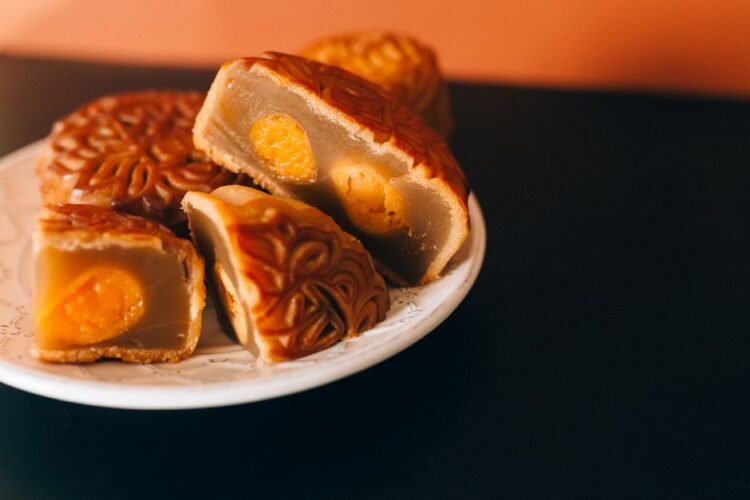
The Five Kernel Mooncake is one of the most traditional Cantonese varieties, filled with a richly textured blend of toasted nuts and seeds bound together with candied winter melon and maltose. Wrapped in a thin golden syrup dough and pressed with intricate patterns, these cakes are baked until glossy and rested for a day so the oils migrate and the crust turns pillowy.
Prep Time60 mins
Cook Time25 mins
Total Time85 mins
Servings8
Yield8 mooncakes
Nutrition Facts
Per serving (estimated)
- 480 kcalCalories
- 24 gFat
- 4 gSaturated Fat
- 60 gCarbs
- 3 gFiber
- 32 gSugar
- 7 gProtein
- 95 mgSodium
- 200 mgPotassium
- 90 mgCalcium
- 3 mgIron
- 1 mgVitamin C
- 25 mcgVitamin A
Ingredients
For the syrup dough
- 200 g cake flour
- 80 g golden syrup (inverted sugar syrup)
- 50 ml peanut oil
- 1 tsp lye water (kan sui)
- 1/4 tsp fine sea salt
For the five kernel filling
- 50 g toasted sesame seeds
- 50 g toasted hulled melon seeds
- 50 g chopped toasted walnuts
- 50 g toasted slivered almonds
- 40 g toasted pine nuts
- 80 g finely diced candied winter melon
- 80 g finely crushed rock sugar
For the filling binder and coating
- 100 g glutinous rice flour
- 50 ml peanut oil
- 40 g maltose syrup
- 50 ml warm water
- 1/4 tsp fine sea salt
- 1 tbsp cake flour for dusting molds
For the egg wash
- 1 large egg yolk
- 1 tbsp water
Directions
- Prepare the dough: whisk the golden syrup, peanut oil, lye water, and salt in a medium bowl until fully emulsified. Add the cake flour and stir with a spatula until a soft, smooth dough forms; wrap in plastic and rest at room temperature for 30 minutes.
- Toast the glutinous rice flour in a dry skillet over low heat, stirring constantly until pale beige and fragrant, about 8 minutes; transfer to a plate to cool completely.
- Make the filling: in a large bowl, combine the five toasted nuts and seeds with the candied winter melon and crushed rock sugar. Stir in the toasted glutinous rice flour, peanut oil, maltose, warm water, and salt, then mix thoroughly by hand until the mixture clumps together firmly when squeezed; it should hold its shape without crumbling.
- Divide the dough into 8 equal portions (about 42 g each) and the filling into 8 equal portions (about 65 g each). Roll each dough piece into a flat round, place a filling ball in the center, and wrap the dough around the filling, sealing tightly with a pinching motion.
- Lightly dust a traditional mooncake mold with cake flour. Press one dough-wrapped ball into the mold, press firmly, then tap out onto a parchment-lined baking sheet. Repeat with the remaining portions, spacing them about 5 cm apart.
- Bake in a preheated 180°C (350°F) oven for 8 minutes to set the imprinted pattern. Remove from the oven and let cool for 5 minutes on the tray.
- Whisk the egg yolk with 1 tbsp water and brush a thin, even layer over the top of each mooncake.
- Reduce the oven temperature to 165°C (330°F) and bake the mooncakes for 12 to 15 minutes more, until the tops are glossy and deep golden. Cool completely on a wire rack.
- Store the mooncakes in a sealed container at room temperature for 24 to 48 hours before eating; this resting period allows the oils to redistribute and the crust to soften to its classic silky texture.
Cook’s Notes
- Toast each nut or seed separately over low heat and cool completely before mixing, otherwise the residual warmth will soften the candied fruit and cause the filling to weep oil.
- Maintain the traditional 40:60 dough-to-filling ratio; a thicker wrapper cracks during baking, while a thinner one cannot hold the heavy nut mixture.
- If kan sui (lye water) is unavailable, dissolve 1/4 tsp baking soda in 1 tsp water as a substitute, though the color and aroma will be slightly different from the classic version.
- Five Kernel mooncakes need at least 24 hours of resting time before eating — fresh out of the oven the crust is dry and chalky, but the next day it becomes tender and almost fudgy.
- Press firmly into the mold; under-pressing leaves fuzzy or incomplete patterns on the finished cake, while over-pressing can crack the outer dough layer.